

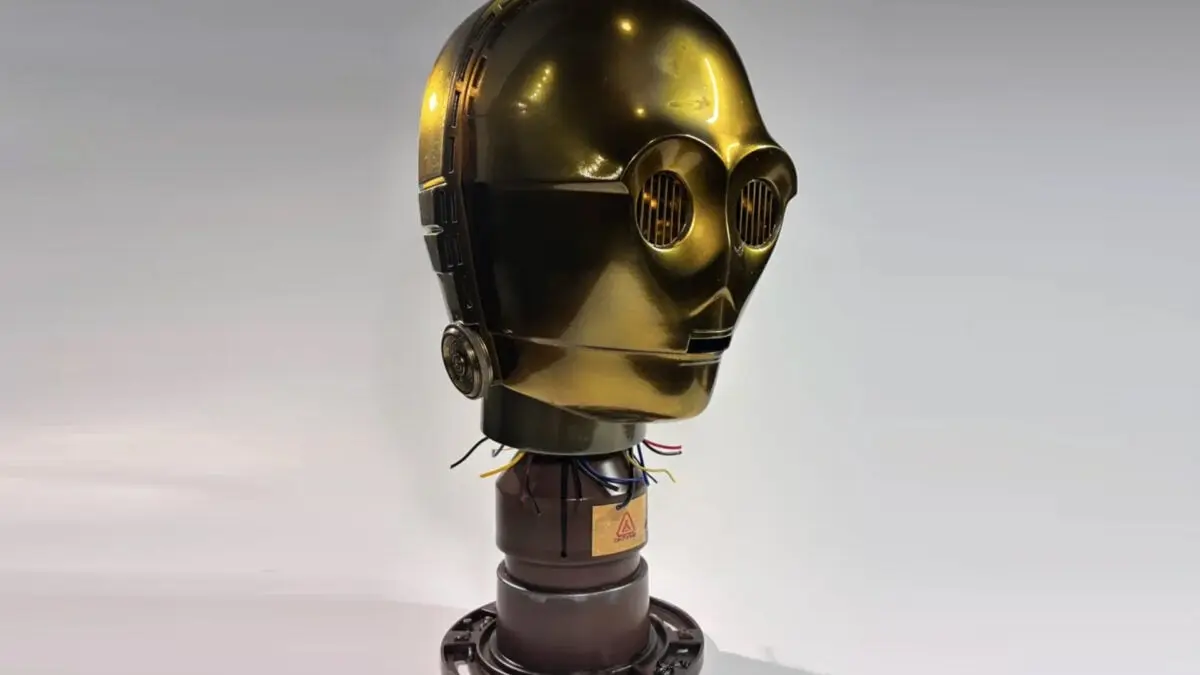
May the fourth be with you, and all that. For Star Wars Day, many fans turn to epic space battles or lightsaber duels, but a growing niche is embracing the more talkative side of the galaxy far, far away. Specifically, they're building their own droids. Among the most beloved is C-3PO, the golden protocol droid whose prissy personality and endless commentary have been a staple of the franchise since 1977. Now, thanks to a student at Chapman University, you can not only build your own C-3PO head, but it will actually talk to you—and it's powered by artificial intelligence.
The original C-3PO head prop from The Empire Strikes Back famously sold for over $1 million at auction last month, becoming one of the most expensive pieces of Star Wars memorabilia ever. That head, separated from Threepio’s body in Cloud City, is a piece of cinematic history. But if you missed out on that seven-figure collectible, fear not. Samuel Potozkin, a student at Chapman University in Orange County, California, has created a DIY replica that not only looks the part but also talks back. He recently posted a video and a detailed paper on GitHub that walks through the entire process.
At its core, the project is a stunning example of how accessible AI and single-board computing have become. The head's speech capabilities are powered by a custom large language model (LLM) imbued with C-3PO’s famously fastidious personality. The pipeline is conceptually simple but technologically elegant: your speech is picked up by a microphone connected to a Raspberry Pi 5. The little computer runs a real-time speech-to-text converter, which transcribes your words into text. That text is then sent as a prompt to the custom LLM, which generates a response in character. The response is run through a text-to-speech system designed to emulate C-3PO’s distinctive vocal delivery, producing a metallic, refined tone.
But getting the voice right was not trivial. In his paper, Potozkin notes that the initial text-to-speech output “did not … align with the metallic vocal tone associated with C-3PO.” To fix this, he applied a series of audio post-processing effects that sound more like a guitarist’s pedalboard than a software engineer’s toolkit. He introduced a short delay line to create tightly spaced temporal reflections, simulating the resonance of a metal body. He also applied a chorus effect by slightly modulating the time and pitch of duplicated signal paths, creating the impression of layered vocal resonance. The result is a voice that is unmistakably Threepio—even before you see the golden head.
The history of DIY droid building in the Star Wars fandom is rich and varied. Long before AI was widely available, fans were building astromech droids from scratch, often using wooden frames, fiberglass shells, and complex servo systems. R2-D2 builders, in particular, have been active for decades, sharing plans at fan conventions and online forums. C-3PO builds are less common because his humanoid form presents greater engineering challenges. However, the focus on just the head simplifies the project while still delivering a striking visual centerpiece. Potozkin’s approach—using a 3D-printed shell, a Raspberry Pi, and an LLM—represents the next step in that evolution: making the droid not just move and look like the character, but actually embody its personality.
The LLM itself is a custom fine-tuned model based on open-source frameworks. Potozkin trained it on C-3PO’s scripted dialogue from the original trilogy, along with transcripts of interviews with actor Anthony Daniels, who played the droid. This gives the model a sense of Threepio’s lexicon, his habit of verbal judo, and his tendency toward exasperated politeness. The model also includes guardrails to prevent it from delivering inappropriate content—after all, even a protocol droid shouldn’t be spouting threats. The text-to-speech engine was selected from several options and then heavily customized with audio filters to match the character’s shrill, metallic cadence.
The implications of this technology extend far beyond fan projects. Recreating iconic voices and personalities using AI has become a booming field, with applications in entertainment, virtual assistants, and interactive museum displays. However, it also raises questions about intellectual property and consent. Potozkin’s project is purely academic and non-commercial, and he explicitly states that it is for personal enjoyment and educational purposes. The use of open-source tools and a GitHub-published paper encourages others to learn and adapt the work without violating copyright. In the broader landscape, similar projects have used AI to simulate the voices of deceased actors or characters, sparking debates about ethics and legality. With C-3PO, the character is owned by Disney, so any commercial use would require licensing.
Beyond the legal considerations, the project offers a fascinating look at how AI can breathe life into inanimate objects. The Raspberry Pi 5, which costs around $80, handles the entire pipeline in near real-time. The speech-to-text and text-to-speech models run locally, meaning no internet connection is required—a deliberate choice to keep the droid responsive without cloud latency. The head itself is 3D-printed in several parts, then painted with a gold metallic finish. Potozkin’s video shows the head mounted on a small stand, with a wire trailing out to the Pi. It’s a convincing replica, especially when illuminated.
If you want to build your own, Potozkin’s GitHub repository includes all the code, 3D printing files, and a list of materials. The total cost for the electronics and printing is under $200, though you’ll need access to a 3D printer and some soldering skills. The paper also details alternative hardware setups, such as using a Raspberry Pi 4 or a Jetson Nano, which might reduce latency at higher cost. For those less interested in building the physical head, the AI pipeline can be adapted to any enclosure—even an old plastic pumpkin or a cardboard box. The important part is the software, which can be reused for other characters by swapping the LLM prompt and voice filters.
As AI continues to advance, projects like this blur the line between prop and companion. Imagine a C-3PO head that can hold a conversation, answer questions about the Star Wars lore, or simply bleep and bloop in complaint just like Threepio would. Potozkin’s work is not just a clever tribute; it’s a demonstration of how accessible DIY AI has become. Anyone with a few hundred dollars and a weekend can now bring a beloved character to life in their own home. Next May the 4th, instead of just watching the movies, you could be having a chat with a golden droid head on your desk. And if you’re feeling generous, you could even lend it out as a party centerpiece. Just be prepared for it to complain about the refreshments.
Source: Gizmodo News