

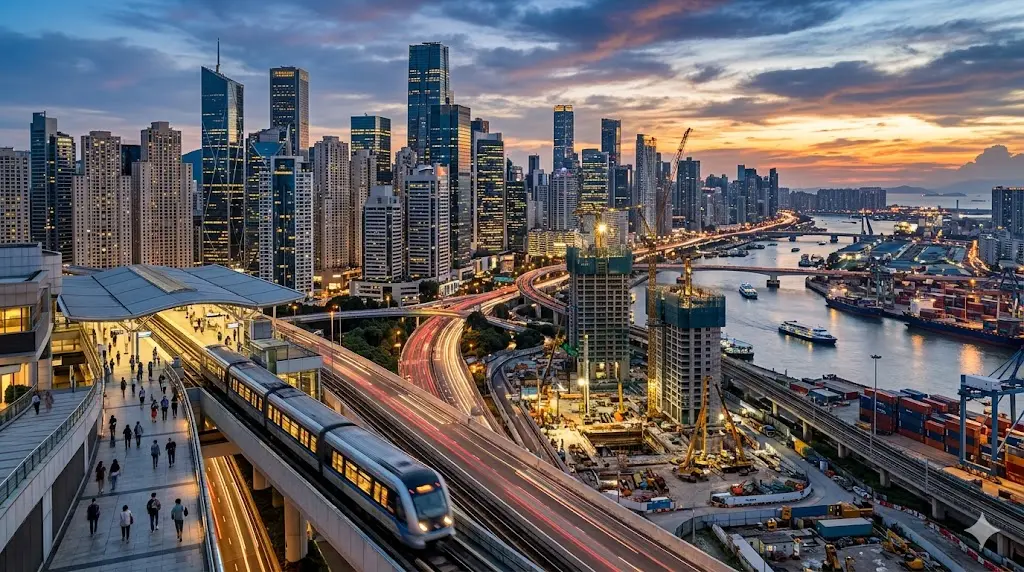
Urbanisation is quietly rewriting how money moves across borders, and why investors pick one country over another. The way cities grow, expand, and concentrate people is directly influencing international investment trends in ways that weren’t obvious even a decade ago. What used to be driven mainly by natural resources or cheap labor is now increasingly shaped by urban infrastructure, housing demand, and the rise of mega-cities.
Here’s the thing: when cities grow fast, capital doesn’t just follow—it rushes in, sometimes faster than governments can even plan for it.
Urbanisation is reshaping international investment trends by concentrating populations in cities, increasing demand for infrastructure, housing, and digital services, and creating high-growth urban economies that attract foreign capital. Investors now prioritize city-level opportunities over national averages, focusing on transport, real estate, smart infrastructure, and urban tech ecosystems.
Urbanisation is the increasing shift of populations from rural areas into cities, leading to the expansion of urban spaces, infrastructure development, and concentrated economic activity.
What Is Urbanisation’s Role in International Investment Trends?
Urbanisation refers to the steady movement of people into cities, but its real impact goes much deeper when you look at money flows. International investment trends are now heavily shaped by how cities expand rather than how countries grow overall.
Think about it like this: investors no longer ask, “Is this country growing?” They’re asking, “Which city inside this country is exploding in opportunity?”
In my experience, this shift is one of the most underestimated changes in global finance. A decade ago, national GDP numbers were enough. Now, investors break things down into city-level data, metro expansion rates, housing shortages, and even commute times.
What most people overlook is that urbanisation doesn’t just create demand—it reorganizes entire economic ecosystems.
Why Urbanisation Matters in 2026 for Global Capital Flow
By 2026, cities are no longer just places where people live. They’ve become independent economic engines competing with entire nations for investment attention. This shift is reshaping international investment trends in a way that feels almost bottom-up rather than top-down.
Let me be direct: global investors are chasing density. Dense populations mean faster consumption, quicker returns, and more predictable demand cycles.
Urban growth also creates pressure points. Housing shortages, transportation bottlenecks, and energy demand spikes all become investment signals. Where those signals appear strongest, capital tends to follow.
There’s also a psychological factor here. Investors see fast-growing cities as “early-stage markets” even if the country itself is mature. That mindset shift alone has changed billions in allocation strategies.
An interesting contradiction appears here: while digitalization was expected to reduce the importance of location, it actually made cities more valuable. Remote work didn’t weaken urban centers—it concentrated high-value industries into select global hubs.
How Urbanisation Drives International Investment Trends Step by Step
Urbanisation influences capital flow through a chain reaction that begins with population movement and ends with large-scale financial restructuring. It’s not random—it follows a surprisingly consistent pattern.
Step 1: Population concentration begins in cities
Rural-to-urban migration increases labor pools, consumer bases, and housing demand almost immediately.
Step 2: Infrastructure pressure builds
Transport systems, energy grids, and public utilities start to stretch, signaling opportunities for large-scale investment.
Step 3: Real estate and land value surge
As space becomes limited, property prices rise, attracting domestic and international investors looking for appreciation and rental yield.
Step 4: Business ecosystems form
Startups, manufacturing clusters, and service industries begin to concentrate in urban zones, increasing economic output.
Step 5: Foreign capital enters aggressively
At this stage, international investors step in to fund infrastructure, tech ecosystems, and commercial expansion.
Step 6: Policy adjustments follow investment
Governments often adapt regulations, tax incentives, and urban planning to manage inflows, which further stabilizes investment environments.
Each step reinforces the next, creating a loop that keeps attracting more capital over time.
Urban Infrastructure as the Hidden Magnet for Global Investment
If there’s one factor that quietly drives international investment trends, it’s infrastructure development inside cities.
Transport systems, smart grids, water management, and digital connectivity all act like invisible magnets. Investors don’t always talk about them publicly, but they absolutely factor them into decisions.
I’ve seen situations where two cities in the same country compete for foreign funding, and the deciding factor isn’t GDP—it’s whether one city has better logistics flow or cleaner energy systems.
Here’s a counterintuitive point: sometimes underdeveloped infrastructure attracts more speculative investment than fully developed systems. Why? Because the growth potential feels larger, even if the risk is higher.
That’s the kind of imbalance that urbanisation creates—and investors know how to play it.
Real-World Investment Shift Example in Fast-Growing Cities
Let’s take a realistic scenario.
Imagine a mid-sized coastal city that suddenly becomes a migration hotspot due to job creation in manufacturing and tech services. Within five years, its population doubles.
At first, local housing becomes scarce. Prices rise. International real estate investors step in, buying early residential projects. Then logistics companies notice congestion at ports and invest in expansion terminals. After that, tech firms begin building regional offices to tap into the growing workforce.
What started as simple migration ends up reshaping international capital allocation patterns.
I’ve personally seen similar dynamics play out in urban corridors where foreign investment wasn’t initially interested—but once density reached a tipping point, money flowed in faster than local systems could absorb.
Expert Tips: What Actually Works for Investors Watching Urban Growth
Here’s what most investment analyses miss: urbanisation is not evenly distributed, even within rapidly growing countries. Some districts expand at breakneck speed while others stagnate for years.
Smart investors don’t just look at cities—they look at micro-urban zones. That’s where the real returns often hide.
Another overlooked factor is timing. Entering too early can be just as risky as entering too late. The sweet spot is usually when infrastructure expansion is approved but not yet completed.
In my experience, the biggest wins come from understanding policy signals rather than just economic data. Cities often “announce” their future growth through planning documents long before physical changes happen.
One Unexpected Twist in Urban Investment Behavior
Most people assume urbanisation always drives stable, predictable growth in investment flows. That’s not entirely true.
In reality, rapid urbanisation can scare away long-term institutional investors due to volatility in housing markets, political pressure on land use, and sudden regulatory shifts.
So while cities attract capital, they also create uncertainty. This tension is what makes urban investment so dynamic—and sometimes chaotic.
People Most Asked About Urbanisation and Investment Trends
How does urbanisation influence foreign direct investment?
Urbanisation increases demand for infrastructure, housing, and services, which attracts foreign investors looking for scalable opportunities. Cities with strong growth often become preferred entry points for global capital.
Why do investors prefer cities over countries?
Cities provide clearer data on consumption, population density, and infrastructure development. This makes investment decisions more precise compared to national-level averages.
Does urbanisation always lead to higher investment?
Not always. If urban growth is unmanaged, it can lead to overcrowding, policy instability, and infrastructure breakdown, which may deter investors.
Which sectors benefit most from urbanisation?
Real estate, transportation, energy, telecommunications, and urban technology sectors tend to benefit the most as cities expand.
Can small cities attract international investment?
Yes, especially if they show strong growth potential, strategic location advantages, or government-backed infrastructure plans.
Is urbanisation slowing down global investment inequality?
Not really. It often concentrates wealth in already growing urban centers, which can widen regional gaps.
What risks come with urban-driven investment trends?
Risks include property bubbles, infrastructure strain, and sudden policy changes aimed at controlling urban expansion.
Digital Growth Platforms
Our network site provide related offering Guest Posting Services and Press Release News Submission, seo and local business listing in uk . Businesses seeking stronger online authority can benefit from press distribution tools like press release distribution services and PR distribution services to boost media coverage, organic traffic, and SEO ranking. For brands aiming to scale visibility through digital marketing services and SEO services, these platforms help secure high authority backlinks and instant publishing opportunities that improve long-term search performance and brand trust.