

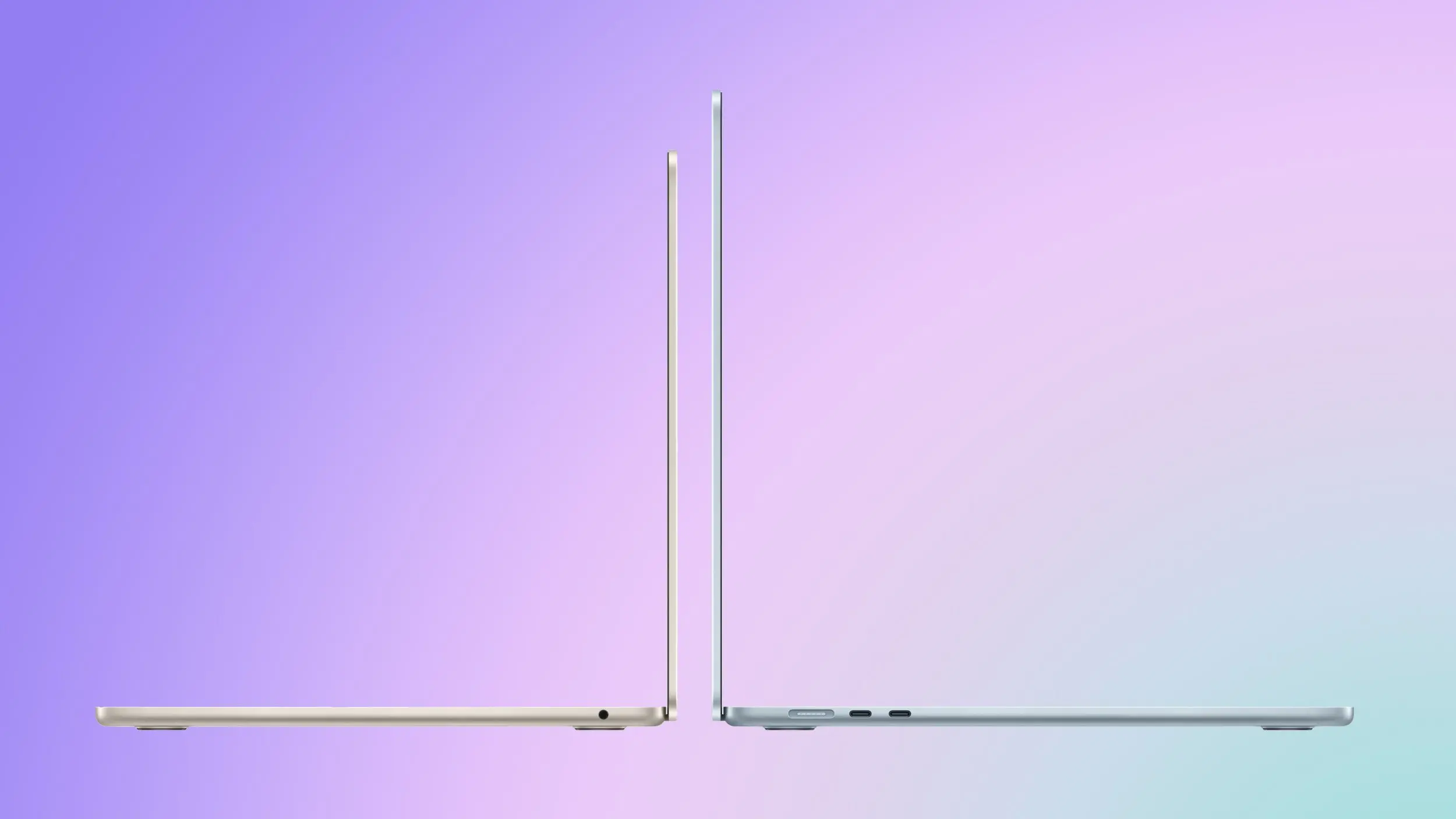
Apple last month announced a new MacBook Air, introducing the M5 chip, faster wireless connectivity, double the base storage, and a more capable charger, while simultaneously discontinuing the M4 model. So how does the new machine compare?
The M5 MacBook Air starts at $1,099 for the 13-inch model and $1,299 for the 15-inch, a $100 increase over the equivalent M4 models. In exchange, base storage doubles from 256GB to 512GB, and Apple says the new SSD delivers twice the read and write speeds of the previous generation. Education pricing is also available directly from Apple and typically shaves at least $100 off the price.
Performance: M5 Chip vs. M4 Chip
The main upgrade between the two models is the chip. Compared to the M4, the M5 delivers up to 15% faster multithreaded CPU performance, up to 30% faster overall graphics performance, up to 45% faster ray tracing performance, and 27.5% higher unified memory bandwidth. In addition to these general performance claims, Apple published a set of specific real-world workload results showing measurable gains in AI-driven applications: 4×+ peak GPU compute performance for AI, 3.6× faster time to first token (LLM), 1.8× faster Topaz Video Enhance AI processing, 1.7× faster Blender ray-traced rendering, and 2.9× faster AI speech enhancement in Premiere Pro.
Beyond raw performance, the M5 introduces several meaningful architectural changes. The GPU includes a dedicated Neural Accelerator in every core, a hardware addition absent from the M4, and Apple is exposing this via new Metal 4 developer APIs with Tensor capabilities. The ray tracing engine advances to its third generation, and dynamic caching moves to its second generation. Memory bandwidth rises from 120 GB/s to 153 GB/s, enabled by the move from TSMC's second-generation 3nm process (N3E) to its third-generation 3nm process (N3P).
Wireless Connectivity and Storage
The M5 MacBook Air also gains Apple's N1 wireless chip, bringing Wi-Fi 7 and Bluetooth 6 in place of the M4 model's Wi-Fi 6E and Bluetooth 5.3. The SSD has been upgraded from PCIe NVMe Gen 3 to Gen 4, delivering approximately twice the read and write speeds. This is particularly beneficial for storage-intensive workflows such as video editing, large file transfers, and running virtual machines.
Detailed Specification Comparison
For a side-by-side look at the technical differences:
- Processor: M4 (based on A18 from iPhone 16) vs. M5 (based on A19 Pro from iPhone 17 Pro).
- CPU cores: M4: 4 performance + 6 efficiency cores; M5: 4 super cores + 6 efficiency cores.
- Manufacturing process: M4: TSMC's second-generation 3nm (N3E); M5: third-generation 3nm (N3P).
- GPU features: M5 adds integrated Neural Accelerators in each core, third-generation ray tracing, second-generation dynamic caching, enhanced shader cores, and Metal 4 APIs with Tensor capabilities.
- Memory bandwidth: 120 GB/s (M4) vs. 153 GB/s (M5).
- External display support: M5 now supports two displays simultaneously over a single Thunderbolt port, including one up to 8K at 60Hz or 5K at 120Hz.
- Charger: 30W USB-C Power Adapter (M4) vs. 40W Dynamic Power Adapter with 60W Max (M5).
- Base storage: 256GB (M4) vs. 512GB (M5), with maximum configurable up to 2TB (M4) or 4TB (M5).
- Pricing: M4 launched at $999 (13-inch) / $1,199 (15-inch); M5 starts at $1,099 / $1,299, effectively $100 less than a similarly configured M4 when factoring the $200 storage upgrade cost.
Who Should Consider the M5 MacBook Air?
For users whose workloads include on-device AI inference, complex 3D rendering, or other GPU-bound and memory-intensive tasks, the jump from M4 to M5 is significant. The combination of per-core Neural Accelerators, higher memory bandwidth, and the new GPU architecture produces multi-fold speed-ups in specific AI operations. In environments where time-to-result directly affects workflow—such as local LLMs, diffusion models, video enhancement, or ray-traced production—the M5 represents a meaningful step-change. The Gen 4 SSD, which delivers approximately twice the read and write speeds of the M4 Air's Gen 3 drive, further compounds these gains for storage-intensive workflows.
For typical day-to-day usage including browsing, office work, media playback, and basic editing, the difference is highly unlikely to be perceptible in any way. The M4 was already a high-performance chip that routinely exceeded the demands of normal Mac workloads, and for the overwhelming majority of M4 MacBook Air owners, there is clearly no general-purpose reason to upgrade.
Value Proposition for New Buyers
For new buyers choosing between the two models, the M5 is the more straightforward long-term choice. The doubled base storage alone changes the value calculus, and when you consider that Apple previously charged $200 to upgrade the M4 Air from 256GB to 512GB, the M5 effectively costs $100 less than a comparably configured M4 model would have at launch. If future-proofing is a priority and you intend to keep the machine for many years, the M5 model will be better equipped to handle increasingly prevalent on-device AI workloads as they mature.
Moreover, the wireless upgrade to Wi-Fi 7 and Bluetooth 6 ensures compatibility with the latest routers and peripherals, while the improved external display support (8K at 60Hz or dual displays over Thunderbolt) appeals to professionals using high-resolution monitors. The new 40W Dynamic Power Adapter with 60W Max offers faster charging when needed, though the 30W adapter of the M4 remains adequate for overnight charging.
The M5 MacBook Air also benefits from Apple's continued investment in on-device AI. With the dedicated Neural Accelerators in every GPU core and Metal 4 Tensor APIs, developers can build applications that leverage machine learning more efficiently than ever before. This positions the M5 as a future-proof investment for those who rely on AI-powered tools like Adobe Sensei, Final Cut Pro's Smart Conform, or third-party apps that use Core ML.
In terms of build quality and design, both models share the same thin and light chassis, 13- and 15-inch Liquid Retina displays, Magic Keyboard, and port selection (two Thunderbolt 4 ports, MagSafe, 3.5mm headphone jack). The only physical difference is the charger included in the box. Thus, the decision boils down to performance needs and budget.
For users currently on an Intel-based Mac, any Apple Silicon model represents a massive leap in performance, efficiency, and battery life. Between the M4 and M5, the choice is less about generational gaps and more about specific use cases. Heavy machine learning practitioners, video editors working with 8K footage, or 3D artists will notice the M5's advantages immediately. General consumers, however, will find the M4's capabilities still excellent—though since the M4 is no longer sold new by Apple, the only new purchase option is the M5. Refurbished M4 units may still be available from third-party retailers at a discount.
In summary, the M5 MacBook Air delivers tangible improvements in AI performance, storage speed, connectivity, and display support. The $100 price increase is offset by the doubling of base storage, making it a better value for most buyers. While the M4 remains a capable machine, the M5 is the clear choice for anyone buying new and expecting to keep their laptop for several years.
Source: MacRumors News