

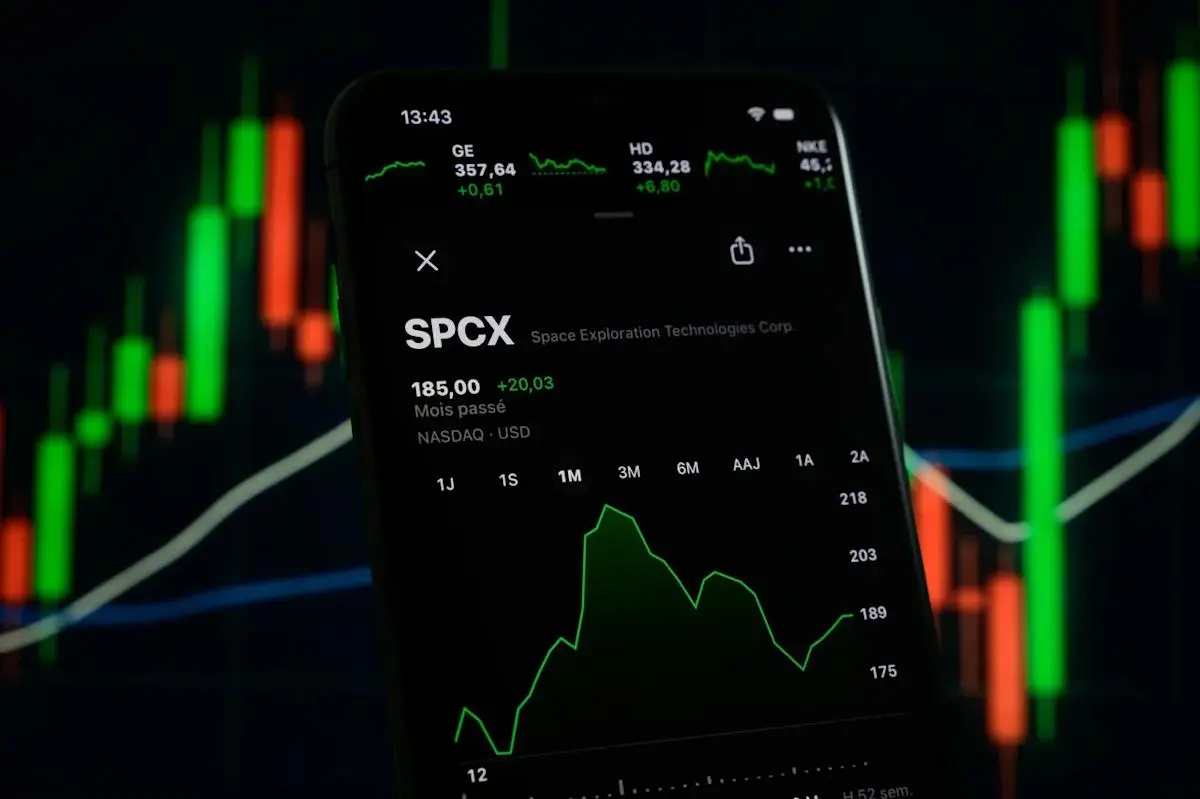
Shares of SpaceX extended their post-IPO slide overnight late Monday by nearly 1%, even as Cathie Wood’s ARK Invest added more shares and economist Peter Schiff mocked Elon Musk’s Buffett-sized paper loss. SPCX stock fell 16% on Monday to close at $154.6, deepening a three-day selloff that has erased 24% from the stock after its blockbuster public debut. The pullback came after shares surged from their $135 IPO price to $220, briefly lifting SpaceX’s market cap above Amazon and Microsoft.
The selloff, while dramatic, is not entirely unexpected for a high-profile IPO that attracted enormous retail and institutional interest. SpaceX’s public listing was the largest in history, raising $75 billion from the sale of 555.6 million shares. The stock’s rapid ascent from $135 to $220 in just a few sessions reflected euphoria around Elon Musk’s space venture, but also raised questions about whether the valuation was sustainable. The subsequent drop has wiped out nearly a quarter of the peak value, bringing the stock closer to its IPO price but still above it.
Cathie Wood’s ARK Invest treated the weakness as a buying opportunity. On Monday, the firm bought a combined 210,121 shares of SPCX across four ETFs. The largest purchase came through the ARK Innovation ETF (ARKK), which bought 131,837 shares. The ARK Autonomous Technology & Robotics ETF (ARKQ) added 43,486 shares, the ARK Next Generation Internet ETF (ARKW) bought 21,506 shares, and the ARK Space Exploration & Innovation ETF (ARKX) picked up 13,292 shares. At Monday’s closing price, the disclosed purchases were worth $32.5 million. This latest buying adds to ARK’s already aggressive exposure to SpaceX. On SpaceX’s Nasdaq debut, ARK bought over 3.29 million shares across several ETFs. SpaceX was also already the largest position in ARK’s Venture Fund, representing more than 11% of net assets, ahead of OpenAI and Anthropic.
Wood’s strategy of buying the dip is consistent with her long-term, high-conviction approach. She has often emphasized that innovation stocks can be volatile but offer outsized returns over time. However, critics argue that ARK’s concentrated bets on high-growth names like SpaceX expose the fund to significant risk if market sentiment shifts. The recent pullback in SPCX has already weighed on ARKK’s performance, though Wood remains unfazed. In a recent interview, she stated that SpaceX’s long-term potential in space travel and satellite communications justifies the current valuation.
The same selloff that ARK treated as a buying opportunity gave Peter Schiff a fresh opening to needle Musk on X: “$SPCX fell 16.5% today. On paper, @elonmusk lost about $150 billion, more than Warren Buffett's entire net worth. However, he's still the world's only trillionaire, so don't feel sorry for him.” According to the Bloomberg Billionaires Index, Musk’s net worth stands at $1.08 trillion, while Buffett’s is at $146 billion. Schiff’s comment highlights the staggering scale of Musk’s wealth and its daily fluctuations, which can exceed the entire net worth of other billionaires. The comparison to Buffett, known for his long-term value investing, also underscores the different philosophies at play—Musk’s high-growth, high-risk ventures versus Buffett’s stable, cash-generating businesses.
Valuation concerns intensified as analyst Mohamed El-Erian called SPCX’s post-IPO swing “Wild!” on X. “In less than ten trading sessions, SpaceX priced its IPO at $135, surged to almost $220, and has now retraced to $166,” he said. “Investors who were lucky enough to acquire their exposure at the IPO are currently up 23%, while those who were very unlucky and bought at the high are down almost 25%.” El-Erian’s warning reflects the binary nature of IPO investing, where timing is critical. Similarly, Future Fund’s Gary Black stated that the stock has “no room for error,” given that it trades at a premium to traditional aerospace companies and even tech giants. SpaceX’s valuation, which briefly exceeded $1 trillion, is based more on future revenue from Starship and Starlink than on current earnings.
SpaceX’s journey from a private company to a public one has been closely watched. Founded in 2002, it revolutionized space travel with reusable rockets and now dominates the commercial launch market. Its Starlink satellite internet service already has over a million subscribers, and the Starship program aims to make interplanetary travel feasible. However, these ambitious projects require massive capital, and the IPO was intended to raise funds for further development. The stock’s volatility since listing suggests that investors are still trying to price in these long-term prospects while reacting to short-term market dynamics.
The broader market context also matters. June 2026 has been a period of mixed economic signals, with inflation concerns and Federal Reserve policy creating uncertainty. Growth stocks, particularly those with high valuations, have been sensitive to interest rate expectations. While SpaceX’s unique position in the space industry provides some insulation, it is not immune to macro trends. The sudden selloff in SPCX could also be attributed to profit-taking after the initial surge, as early investors lock in gains.
Retail investors have been active in SPCX, with social media platforms like Stocktwits buzzing. Many are divided—some see the dip as a chance to buy at a discount, while others fear further declines. The stock’s options market has seen heavy activity, with high implied volatility suggesting that traders expect continued swings. For now, the consensus among analysts is caution, as the stock’s fair value remains uncertain without a clear earnings trajectory.
Among the key figures watching SPCX is Cathie Wood, whose ARK funds have become synonymous with disruptive innovation. Her decision to add shares during the selloff signals a bet that the dip is temporary. However, if the stock continues to fall, ARK’s exposure could become a liability. The same applies to Musk, whose net worth is heavily tied to Tesla and SpaceX. The paper loss of $150 billion cited by Schiff is a theoretical calculation based on Musk’s ownership stake in SpaceX, which remains substantial. Unlike realized losses, paper losses do not directly affect cash flow but can influence borrowing and investor sentiment.
SpaceX’s IPO has also drawn comparisons to other mega-debuts like Rivian, DoorDash, and Coinbase, all of which experienced post-IPO volatility. These examples show that even strong companies can see their stocks gyrate as the market finds a pricing equilibrium. The difference with SpaceX is its unique business model and charismatic founder, which may continue to drive outsized interest and price swings. For long-term believers, the current pullback might be an opportunity, but for those with shorter horizons, the risk is palpable.
Looking ahead, SpaceX’s next catalysts include the successful launch of Starship to Mars, further Starlink subscriber growth, and potential government contracts. These events could reignite enthusiasm for the stock. Until then, the market will likely remain focused on the IPO’s price action and the narratives from figures like Wood and Schiff. The story of SPCX is far from over, and the coming weeks will test whether the stock can stabilize or if the selloff has further to go.
Source: Yahoo Finance News