

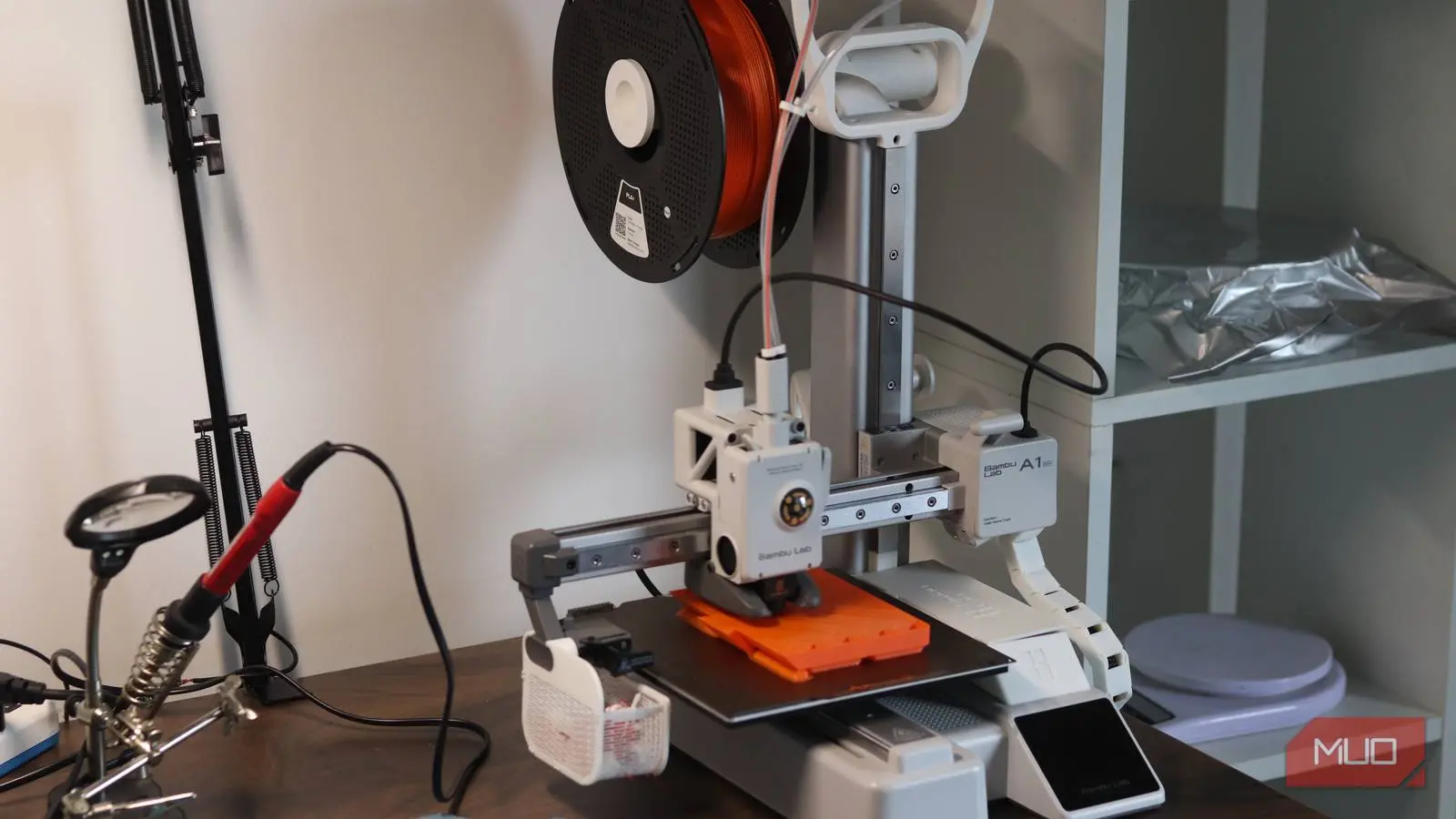
I had prior experience with 3D printing long before I ever owned one. In 2017, fresh out of high school, my first job involved repairing and maintaining two 3D printers – an experience that both hooked me on the technology and kept me from buying one for nearly a decade. Those early machines were finicky, loud, and demanded constant attention. When I finally purchased a modern 3D printer in 2026, almost every assumption I held turned out to be wrong.
The printer was never the problem
I overestimated the noise, space, and disruption a 3D printer would bring
My early experience centered on the Wanhao Duplicator 3 – a massive, heavy industrial-style printer with a small build volume but a huge enclosure. Slicing files on a PC, transferring them to a microSD card, and then manually leveling the bed with a sheet of paper was a ritual that often ended in failure. The machine was unbearably loud, with rattling stepper motors and fans that could drown out conversation. I wanted a printer that could sit on my electronics workbench next to my desk, but I assumed any such machine would be too large, too noisy, and too disruptive.
When I unboxed the Bambu Lab A1 Mini, all those worries evaporated. The printer has a tiny footprint – roughly the size of a shoebox – and its minimalist design blends into any workspace. During operation, the motors are nearly silent; the only audible component is the cooling fan, which is no louder than a laptop fan under load. I now run print jobs all day while working at my desk less than a meter away, and the background hum becomes unnoticeable after a few minutes.
Speed mattered less than I expected
Long print times stopped feeling important once the printer could work unattended
My fear of time had two layers. First, I associated 3D printing with glacial speeds – a small part taking the better part of a day. The A1 Mini shattered that belief. It prints a standard Benchy test boat in roughly 20 minutes at default settings, and real-world functional prints like brackets, enclosures, and organizers – which make up the bulk of my output – finish in a fraction of the time older machines would have needed. The CoreXY motion system and high-flow hotend enable rapid acceleration and consistent extrusion, making speed a non-issue.
The second layer was the attention a print required. Modern printers have changed this entirely. Automatic bed leveling happens before every print, eliminating the manual ritual. Filament runout detection pauses the job if the spool runs dry, preventing ruined prints. A built-in camera allows remote monitoring via the Bambu Handy app, and with a Home Assistant integration, I can check progress from my smart home dashboard. I've started prints hundreds of kilometers away while traveling and returned to a flawless object waiting on the build plate. With proper calibration and maintenance, 3D printing becomes a background process – not a time-consuming chore.
Maintenance turned out to be mostly a myth
Modern printers require far less tinkering than their reputation suggests
Beyond print time, I expected ongoing maintenance to eat into my schedule. In 2017, lucky days meant avoiding a clogged nozzle or re-leveling the bed for the umpteenth time. I mentally budgeted for regular belt tension checks, nozzle swaps, and bed calibration as a recurring cost. The reality has been the opposite. In over 134 hours of printing on the A1 Mini, the only intervention I've performed is calibrating a new spool of filament – and even that wasn't strictly necessary, since generic PLA profiles work well across multiple brands. The printer's self-diagnostics and robust hardware design have made it a reliable home appliance rather than a workshop tool.
The one area where expectations still meet reality is multi-color printing with add-on systems like the AMS Lite. I chose not to get one because of the significant waste and increased time it introduces. But for everyday prints – custom ESP32 enclosures, mounting brackets, cosmetic parts, replacement components – the experience has been remarkably frictionless. A simple wipe of the build plate with isopropyl alcohol every few prints and occasional rail lubrication is all the maintenance required.
The biggest mistake was waiting so long
I should have bought a 3D printer years earlier instead of overthinking it
I purchased the A1 Mini just before Bambu Lab implemented controversial firmware restrictions, but the company still produces excellent hardware. However, the broader 3D printing ecosystem has evolved dramatically. Machines from Creality, Elegoo, and Prusa now behave more like home appliances than hobbyist tools. They arrive calibrated, feature silent stepper drivers, automatic bed leveling, and cloud connectivity. The industry has moved from the RepRap ethos of self-repair to a consumer-friendly model where you can unbox, load filament, and print within minutes.
The psychological barrier I faced was rooted in outdated assumptions. The 3D printing landscape of 2017 was defined by constant tweaking, failed prints, and noisy operation. That world no longer exists for mainstream machines. If your hesitation, like mine, was about time – both the duration of prints and the attention they demand – modern 3D printers have addressed both concerns. They are fast, reliable, and they get out of your way. I wish I had stopped waiting and bought one years earlier, rather than clinging to a decade-old mental model of what 3D printing meant.
For anyone on the fence, consider the practical benefits: prototyping custom parts, creating organization solutions, repairing broken household items, or exploring artistic projects. The technology has matured to the point where it no longer requires a dedicated hobbyist mindset. It's a tool as accessible as a paper printer, but with far more creative potential. Don't let past reputation dictate your present decision – the world of 3D printing has changed, and it's better than ever.
Source: MakeUseOf News