

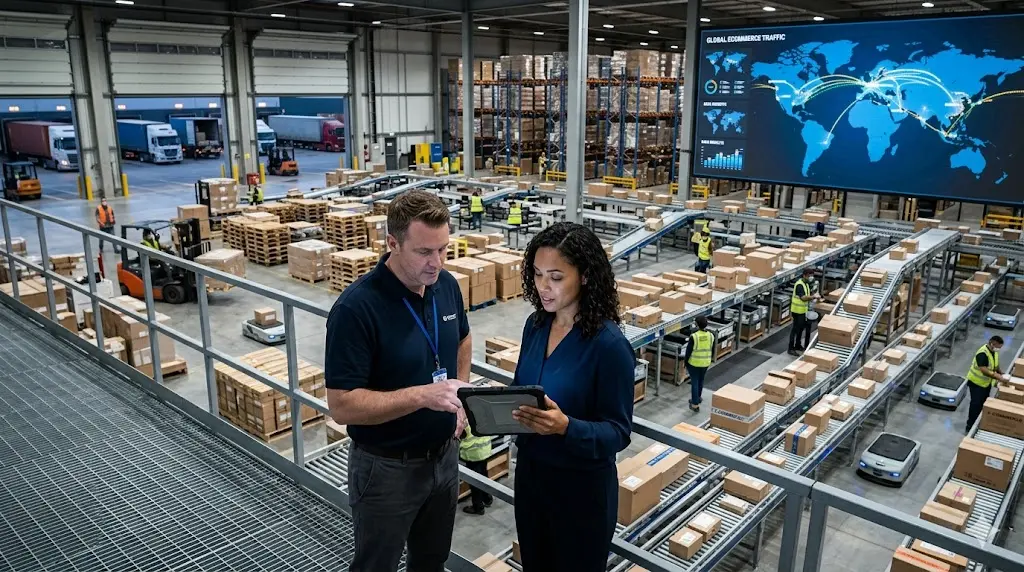
Supply chains in global ecommerce aren’t just about moving products from one place to another anymore. They’re the backbone of how fast brands grow, how customers experience delivery, and honestly, how businesses survive in competitive markets. When I first started looking into supply chains in global ecommerce, I thought it was mostly about shipping and warehouses. I was wrong—it’s a complex web of suppliers, data, demand signals, and last-mile execution.
Here’s the thing: if your supply chain stumbles even slightly, customers notice immediately. And in global ecommerce, “immediately” often means lost trust. In this article, I’ll break down how these systems actually work, why they matter more in 2026 than ever before, and what real businesses are doing to stay ahead.
Supply chains in global ecommerce are interconnected systems that manage sourcing, production, storage, and delivery of products across countries to meet online demand efficiently. They matter because customer expectations for fast, transparent delivery keep rising. Businesses that optimize logistics, inventory flow, and supplier coordination can reduce delays, cut costs, and scale internationally with fewer disruptions.
What Are Supply Chains in Global Ecommerce and Why Do They Matter?
Supply chain in global ecommerce is the end-to-end system that moves a product from raw material sourcing to final delivery across international digital marketplaces.
Now, let’s make that simpler. Think of it as a chain reaction. A supplier in one country produces goods, another handles packaging, a third manages storage, and multiple logistics partners ensure delivery to a customer thousands of miles away.
What most people overlook is how digital this has become. Supply chains aren’t just physical anymore. They’re powered by real-time data, predictive demand systems, and sometimes even automated purchasing decisions.
In my experience, businesses that treat supply chains like “background operations” usually struggle once they expand internationally. The moment you add borders, currencies, and customs regulations, things get messy fast.
And honestly, that’s where most ecommerce brands underestimate the challenge.
The most stable supply chains aren’t the fastest—they’re the ones that can absorb disruption without breaking customer experience.
Why Supply Chains in Global Ecommerce Matter in 2026
The year 2026 has pushed ecommerce into a different reality. Customers expect next-day or even same-day delivery regardless of geography, and that expectation is shaping everything behind the scenes.
Supply chains in global ecommerce now sit at the center of three major pressures: speed, transparency, and unpredictability. A small delay in one country can ripple across continents.
Let me be direct—many businesses still operate with outdated assumptions. They think more warehouses automatically solve problems. It doesn’t. Sometimes it just creates more friction points.
Here’s what I’ve noticed in real-world cases: companies that integrate demand forecasting with supplier networks tend to outperform those that simply “scale inventory.” It’s not about having more stock; it’s about having the right stock in the right place at the right time.
What’s also shifting in 2026 is consumer awareness. People now track orders obsessively. If tracking stops updating, trust drops instantly.
Visibility matters more than speed. A slightly slower delivery with accurate tracking often beats a fast delivery with uncertainty.
How to Optimize Supply Chains in Global Ecommerce — Step by Step
Improving supply chains in global ecommerce isn’t about one big fix. It’s a series of practical decisions stacked together. Here’s a breakdown that actually reflects how businesses operate in real life.
1. Map your entire supply structure
Start by understanding every step your product takes. Not just suppliers and shipping partners, but packaging vendors, customs handlers, and storage nodes. Most inefficiencies hide in “unknown middle layers.”
2. Align demand forecasting with real behavior
Instead of relying purely on historical sales, combine seasonal patterns with current market signals. This reduces overstock and prevents stockouts.
3. Diversify logistics routes and partners
Relying on a single shipping route is risky. Weather, regulations, or political delays can break the chain quickly.
4. Build inventory buffers in strategic locations
Not everywhere—just key regional points where demand spikes are predictable.
5. Connect data across all systems
When inventory systems don’t talk to logistics systems, things fall apart quietly before you even notice.
6. Test disruptions before they happen
Simulate delays, supplier failures, or shipping interruptions. It sounds unnecessary until the first real disruption hits.
Expert tip: Over-automation without human oversight can backfire. Systems still need someone who understands context, not just dashboards.
Common Mistake: Thinking More Inventory Fixes Everything
A lot of businesses assume that increasing stock solves supply chain issues. It usually doesn’t. In fact, it can make things worse.
I’ve seen brands double their warehouse capacity only to realize their delivery delays stayed the same. Why? Because the bottleneck wasn’t storage—it was coordination between suppliers and logistics partners.
Here’s the counterintuitive part: less inventory in the wrong places can outperform more inventory spread inefficiently.
That’s something most guides won’t tell you, but it shows up repeatedly in real operations.
What Actually Works in Real Supply Chains
Let me share a more personal observation here.
In one project I reviewed (a mid-sized ecommerce brand selling across Asia and Europe), their biggest breakthrough didn’t come from software upgrades or warehouse expansion. It came from simplifying decision layers. They reduced approval steps between procurement and shipping from five levels to two. Delivery time dropped noticeably within months.
That’s why I often say: complexity is the silent killer of global ecommerce supply chains.
What actually works tends to be surprisingly simple:
clearer supplier communication rhythms
fewer but stronger logistics partners
tighter feedback loops between sales and inventory
Expert tip: If you can’t explain your supply chain flow in under two minutes, it’s probably too complicated to scale.
Another thing people miss is cultural and regional timing differences. A delay isn’t always a logistics failure—it can be a coordination mismatch across time zones.
And here’s my honest opinion: companies that obsess over tools instead of coordination usually end up frustrated. Tools help, but they don’t fix communication gaps.
People Most Asked About Supply Chains in Global Ecommerce
What makes global ecommerce supply chains different from local ones?
Global ecommerce supply chains deal with multiple countries, regulations, and shipping systems. That alone introduces complexity that local systems don’t face. Even small delays at customs can impact entire delivery cycles.
How do companies reduce delays in international shipping?
Most reduce delays by diversifying shipping routes, improving customs documentation accuracy, and using predictive demand systems. It’s rarely one fix—it’s a combination of small improvements.
Why do supply chain disruptions happen so often?
Disruptions happen because global systems are interconnected. A delay in raw materials, weather events, or regulatory changes can ripple across the entire chain quickly.
Is faster shipping always better for ecommerce success?
Not always. Faster shipping without accuracy or visibility can frustrate customers more than slightly slower but reliable delivery. Trust often matters more than speed alone.
What role does technology play in modern supply chains?
Technology helps with forecasting, tracking, automation, and coordination. But it works best when paired with human oversight and practical decision-making.
Can small ecommerce businesses compete globally with large supply chains?
Yes, but they usually do it through focus rather than scale. Smaller businesses often win by being more flexible and responsive, not by matching large infrastructure.
If you’re looking to strengthen brand visibility and improve SEO ranking through high authority backlinks and organic traffic growth, platforms like Press Release Power and Rank Locally UK provide practical support through press release distribution services, SEO services, and digital marketing agency solutions. These services help businesses gain media coverage, improve online press release distribution, and access performance-driven link building services that can significantly boost digital reach. For startups and agencies aiming for instant publishing and stronger online presence, these tools can make a measurable difference in competitive markets.