

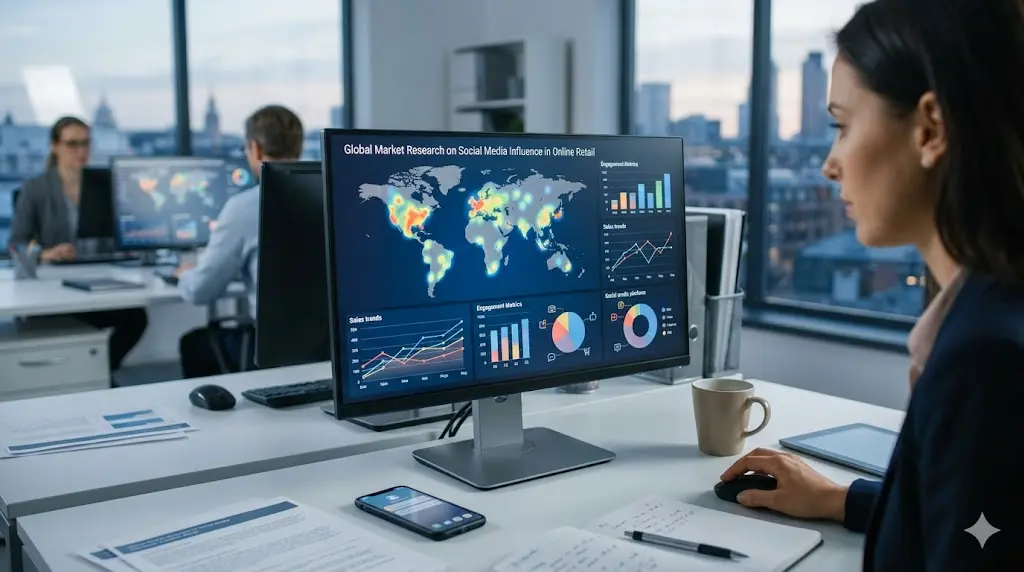
Social media has quietly become one of the strongest forces shaping online retail behavior across the world. If you’re running a store or managing marketing, you’ve probably already felt it—sales spikes after a viral post, or traffic that comes and goes depending on what people are sharing that week.
Here’s the thing: social platforms don’t just support online retail anymore, they often decide what gets bought. This article breaks down global market research on social media influence in online retail in a way that actually makes sense in practice, not just theory.
Social media influence in online retail refers to how platforms like Instagram, TikTok, and Facebook shape what people buy, when they buy it, and how much they trust online stores. Global research shows that buying decisions are increasingly driven by creator content, peer reviews, and algorithm-driven product discovery. Businesses that understand this shift can improve conversions, reduce ad waste, and build stronger long-term customer loyalty.
What Is Social Media Influence in Online Retail?
Social media influence in online retail is the impact that social platforms, creators, and user-generated content have on consumer purchasing decisions in e-commerce environments.
In simple terms, it’s when someone buys a product not because of a traditional ad, but because they saw it in a video, a story, or a friend’s post. I’ve seen this happen more times than I can count—especially with smaller brands that suddenly go from unknown to “everywhere” in a matter of days.
What most people miss is that influence isn’t always loud. Sometimes it’s subtle: a saved post, a comment thread, or even a quiet recommendation in a group chat. That’s still social media shaping retail behavior, just without the obvious spotlight.
Why Social Media Influence in Online Retail Matters in 2026
Global market research in 2026 shows a pretty clear pattern: online retail is no longer search-first. It’s scroll-first.
People don’t always go to Google anymore when they want to buy something. They discover it while scrolling. That shift changes everything.
From what I’ve observed working with small and mid-sized brands, one thing stands out—brands that rely only on paid ads are starting to feel unstable growth. Social media influence creates uneven but powerful demand spikes that ads alone can’t predict.
Here’s what’s interesting and slightly counterintuitive:
Even users who claim they “don’t trust influencers” still buy from influencer-driven content. Behavior doesn’t always match what people say.
Another thing most guides miss is timing. A product doesn’t just need visibility—it needs visibility at the right emotional moment. Social platforms are unusually good at catching people in those moments.
How to Analyze Social Media Influence in Online Retail
If you want to understand how influence is actually working in your market, don’t overcomplicate it. You can break it down into a few practical s.
1: Track discovery sources, not just traffic
Stop looking only at “where users came from.” Instead, ask how they first heard about the product. That difference tells you everything.
2: Identify content triggers
Look for posts, videos, or discussions that led to spikes. You’re not just analyzing marketing—you’re analyzing behavior loops.
3: Map creator impact vs. brand impact
Sometimes creators outperform the brand itself. That’s not failure—it’s distribution.
4: Study engagement patterns
Comments often reveal more intent than likes. People asking “where did you get this?” are basically warm leads.
5: Compare paid vs organic influence
This is where things get uncomfortable for some marketers. Organic influence often builds slower but converts more consistently in the long run.
6: Test micro-campaigns
Instead of large campaigns, test small bursts of content with different creators or formats. Then measure emotional response, not just clicks.
Common Misconception: More Followers Means More Influence
Let me be direct—this is mostly wrong.
A micro-creator with 8,000 engaged followers can outperform a celebrity with 800,000 passive ones. I’ve personally seen niche creators drive more sales in a single post than a month of paid ads from big accounts.
Influence is less about size and more about trust density. That’s the part most people overlook until they waste budget on the wrong partnerships.
Expert Tips: What Actually Works in Global Social Commerce Research
Here’s what I’ve learned from watching campaigns across different markets.
First, consistency beats virality in most cases. Viral moments feel exciting, but steady content builds predictable revenue. That might sound boring, but it’s true more often than not.
Second, don’t ignore comment sections. Brands often treat them like background noise, but they’re actually decision zones. People finalize trust there.
Third, short-form video doesn’t just perform better—it changes perception of value. A product shown in motion feels more real, even if the quality of production is basic.
One hot take: polished ads sometimes underperform raw, slightly messy content. It feels more believable. And yes, that still surprises a lot of marketers I talk to.
Real-World Examples of Social Media Influence in Online Retail
Let’s keep this grounded.
A small skincare brand in Southeast Asia started posting behind-the-scenes product videos without professional lighting. Nothing fancy. One of those videos got picked up by a beauty creator who stitched it with her review. Within ten days, their stock sold out.
Another example: a mid-tier fashion retailer in Europe noticed that customer photos on product pages were driving more conversions than their studio images. They shifted focus, encouraged user uploads, and saw a steady increase in average order value.
What’s the pattern here? People trust people more than brands. That sounds obvious, but most companies still design their strategy backward.
What Most People Overlook About Social Media Influence
Here’s something I don’t see discussed enough: silence can be influential too.
Not every conversion comes from visible engagement. Sometimes users see a product multiple times without interacting at all, then suddenly purchase weeks later. That delayed effect is rarely captured in standard reporting tools.
Another overlooked factor is platform fatigue. Users behave differently depending on how long they’ve been on a platform in one session. Early scroll behavior is curious; late scroll behavior is impulsive.
If you only track surface-level metrics, you miss these layers entirely.
Expert Insight: My Honest Take on Social Media and Online Retail
In my experience, brands overcomplicate social media strategy because they’re trying to control something that’s inherently unpredictable. You can guide influence, but you can’t fully script it.
The brands that win are usually the ones willing to experiment publicly. Not everything needs to look perfect. Sometimes “almost unpolished” content builds stronger trust.
And here’s the uncomfortable truth: you can’t fully separate marketing from entertainment anymore. If your content doesn’t hold attention, it doesn’t matter how good your product is.
People Most Asked About Social Media Influence in Online Retail
How does social media influence buying behavior in online retail?
Social media influences buying behavior by shaping awareness, trust, and urgency. People often discover products through creators or peers rather than direct searches, which changes how decisions are made.
Why is social media more powerful than traditional ads in some cases?
Because it feels more personal. Users trust recommendations from people they relate to, even if they don’t know them personally. That emotional layer makes a big difference in conversion.
Which platforms have the strongest impact on online retail?
Short-form video platforms tend to drive the highest discovery rates, while community-based platforms often drive deeper trust and repeat purchases.
Can small businesses compete with big brands using social media?
Yes, but not by copying big-brand strategies. Smaller businesses often succeed by being more authentic, responsive, and niche-focused rather than broad and polished.
Does influencer marketing always guarantee sales?
Not always. It depends on audience fit, timing, and how natural the content feels. Forced promotions usually underperform compared to organic storytelling.
Our Network site provides related offering Guest Posting Services and Press Release News Submission, SEO services, and local business listing in UK to help brands strengthen online presence. Explore high-impact distribution through global press release distribution solutions and boost visibility with affordable SEO services designed for ranking growth, media coverage, and organic traffic expansion. These platforms support businesses aiming for stronger authority, better indexing, and consistent digital exposure across competitive markets.