

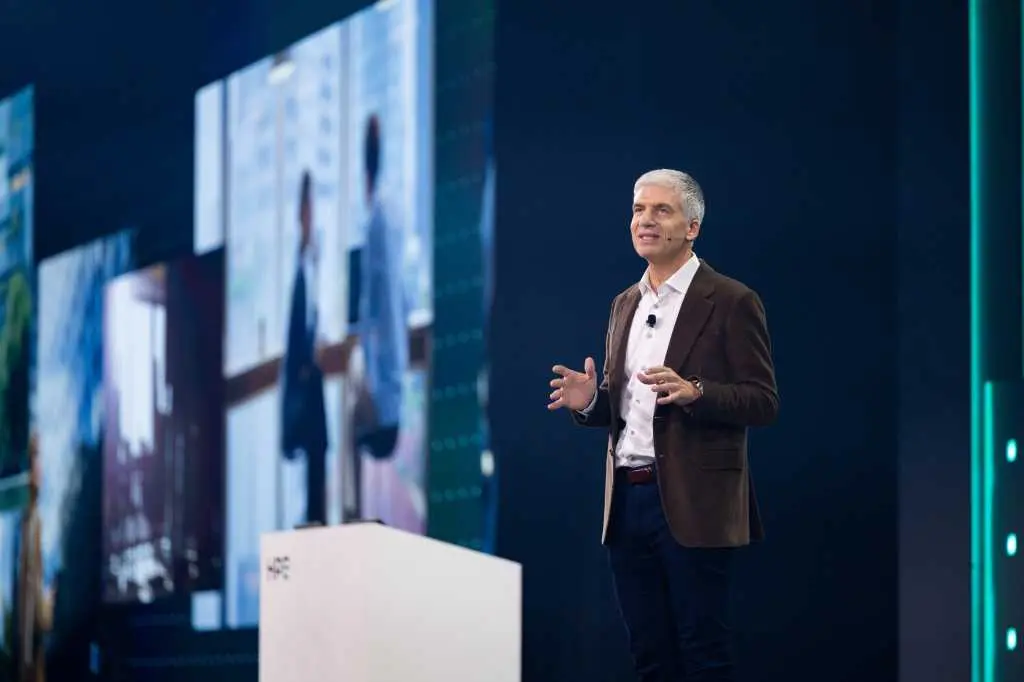
At the HPE Discover event in Las Vegas last week, Rami Rahim, former CEO of Juniper Networks and now executive vice president, president, and general manager of HPE Networking, delivered a decisive message to network professionals: legacy network architectures are fundamentally incapable of supporting the demands of artificial intelligence. Speaking to a packed audience after HPE CEO Antonio Neri’s keynote, Rahim framed the conversation around one core idea—network foundations. “AI is reshaping every part of the enterprise,” he said, “but none of that happens without the right foundation underneath it. And that foundation starts with the network.”
For network engineers, the keynote offered a clear blueprint of what the future holds and how their roles must evolve. Below are the five key themes that emerged from Rahim’s presentation and the implications for day-to-day work and career trajectory.
The network is now the AI foundation
Rahim opened with a powerful analogy: San Francisco’s Millennium Tower, a skyscraper that began to tilt because its foundation was not designed for long-term environmental pressures. He compared this to enterprise AI deployment, where massive data movement, constant inference, real-time responsiveness, and explosive scale will cause any network not built for this new era to fail. “The network is no longer infrastructure sitting quietly in the background,” he said. “It’s become the strategic platform for how organizations operate, innovate, and scale.” He warned that organizations can invest billions in GPUs, but if the network introduces latency, bottlenecks, and instability, performance will be severely limited.
What this means for network engineers: They must design for AI-era baselines rather than legacy traffic assumptions. This involves planning for sustained east-west flows, low jitter, and deterministic paths that support both AI training and inference, not just classic north-south traffic. Engineers need to translate network health into business outcomes for AI, such as linking latency and packet loss to model training time or inference SLAs. They should also get involved early in AI projects to ensure connectivity and data movement patterns are engineered from the start.
AI for networks: self-driving operations become table stakes
The core thesis of Rahim’s presentation was that legacy networks cannot withstand the rigors of AI. “The old model of networking—static, manual, and reactive—simply cannot keep up with the speed and complexity AI introduces,” he stated. His alternative is an AI-native, self-driving operations model spanning Aruba Central and Mist, powered by Marvis, Marvis Minis, and an agentic AI framework. On stage, he was joined by Sunalini Sankhavaram, vice president of product management at HPE, who elaborated on the shift. “Experience-first AI in action is built on real-life experience data—every user, every minute—validated against real customer support cases and enriched with digital twins.” In one demonstration, Marvis detected that over 6% of user minutes were bad, isolated the issue to a few overutilized access points, and autonomously fixed the problem by enabling dual-band 5 GHz, cutting peak utilization from 90% to 54%. Rahim summarized: “The network identified the issue, understood the root cause, determined the right action, and resolved the problem automatically before any user even had a chance to complain.”
For engineers, this represents a fundamental shift from being the resolver to configuring, supervising, and governing these AI systems. They must lean into AIOps rather than treating it as a dashboard, feeding full-fidelity telemetry into platforms like Mist and Aruba Central and actively testing recommendations. Their value increasingly lies in defining SLAs, allowed action scopes, and approval workflows for autonomous changes. They also need to learn the new language of operations—SLAs and “bad user minutes”—which will become the common currency between IT and the business.
One AI-native fabric across campus, branch, and routing
A major structural message in the keynote was unification: Juniper plus Aruba, Mist plus Central, wired plus wireless plus routing, all tied together by a common AI engine. Sankhavaram explained that with microservices, they can develop self-driving innovations once and deploy them on both HPE Aruba Central and HPE Mist platforms. Marvis is being integrated into the global north view in Aruba Central, including the Marvis Trust List—actions that can run fully autonomously, such as automatically recovering a dead camera port to restore video without human intervention. On the hardware front, HPE has already shipped a dual-platform access point and is bringing the HPE networking CX portfolio to Mist for day zero, day one, and day two operations. Rahim articulated the design principle: “Our mission is simple. Bring the best innovations to both platforms, so that every customer in every industry gets the same powerful self-driving network.”
Advice for engineers: Design for platform optionality, assuming that management planes may change over the life of hardware. Favor equipment that can switch between Mist and Central without rip-and-replace. Embed digital twins into workflows—experience twins and synthetic testing should be part of pre-deployment validation and change management. Build API-first automation muscle; Sankhavaram emphasized an API-first approach, making data and actions accessible programmatically, which deepens skills in Python, CI/CD, and infrastructure-as-code.
Networking and security converge with AI-aware controls
Rahim repeatedly stressed that networking and security can no longer operate separately. “Attackers are already using the network as their weapon of choice,” he said, “and with AI making threats faster, smarter, and more sophisticated, defenders need to use the network as part of their defense.” This aligns with research showing that 83% of network engineers now have security as part of their remit. Customer voices underscored the point: Royal Bank of Canada’s Marlon Drummond said, “Security for us is job number one. We don’t have any other job other than protecting our client data.” RBC troubleshoots at the network layer, the only place to get immutable evidence, using SD-WAN and deep packet inspection to create a persona for a user and treat deviations as anomalies.
On the product side, HPE announced a unified SASE orchestrator that combines Edge Connect SD-WAN with SSE stack into a single console. The session also showcased an AI-aware firewall that distinguishes between sanctioned, unsanctioned, and tolerated AI apps, enforcing fine-grained guardrails on uploads, prompts, and keywords. This lets customers see, govern, and protect how AI is used across their organizations without slowing down business. For network engineers, this means they will own more of the zero-trust and AI-governance story, implementing policies like “block ChatGPT, tolerate Gemini with upload and keyword controls” in their SASE and firewall fabric. They must instrument the network as a primary security sensor, building detection pipelines around network telemetry and lateral movement patterns. Self-driving changes must respect segmentation and zero-trust boundaries, requiring engineers to think like both a network engineer and a security architect.
Experience-first networking at real-world scale
The most compelling parts of the keynote were customer segments showcasing just how unforgiving modern environments have become. Ohio State CIO Rob Lowden described a campus that is a small city with 66,000 students, 8,500 faculty, 22,000 HPE access points, and a football stadium that can see over 200,000 people on game day. With that density, AI ops are needed to crunch data in real time, reducing problem resolution from hours to minutes. At Sentara Health, director Tom Johnson highlighted the criticality of network in healthcare: “We move massive amounts of data across the organization, and it directly impacts patient care. That’s why our network must be resilient, secure, and always available.” Ambient AI that listens to patient conversations and generates clinical notes is already in production, but it requires real-time, reliable, secure data delivery.
Disney’s Ben Croy, who runs global networking, described studio networks where a single animated feature could generate a petabyte of content, with over 200 concurrent productions globally. The requirement is speed and simplicity; the network must be foundational yet invisible so filmmakers focus on story. Network engineers should take these stories as lessons to measure what users feel, not just what devices report. Adopt SLAs around app quality as primary KPIs and design telemetry and AI-ops to optimize those. Use AI-driven digital twins and synthetic tests to avoid disasters before they happen, pre-testing big launches with synthetic users and paths. Finally, become a vertical expert—understanding domain-specific workflows in healthcare, finance, education, or media allows engineers to prioritize and tune the network for what matters to clinicians, traders, students, or artists.
Source: Network World News