

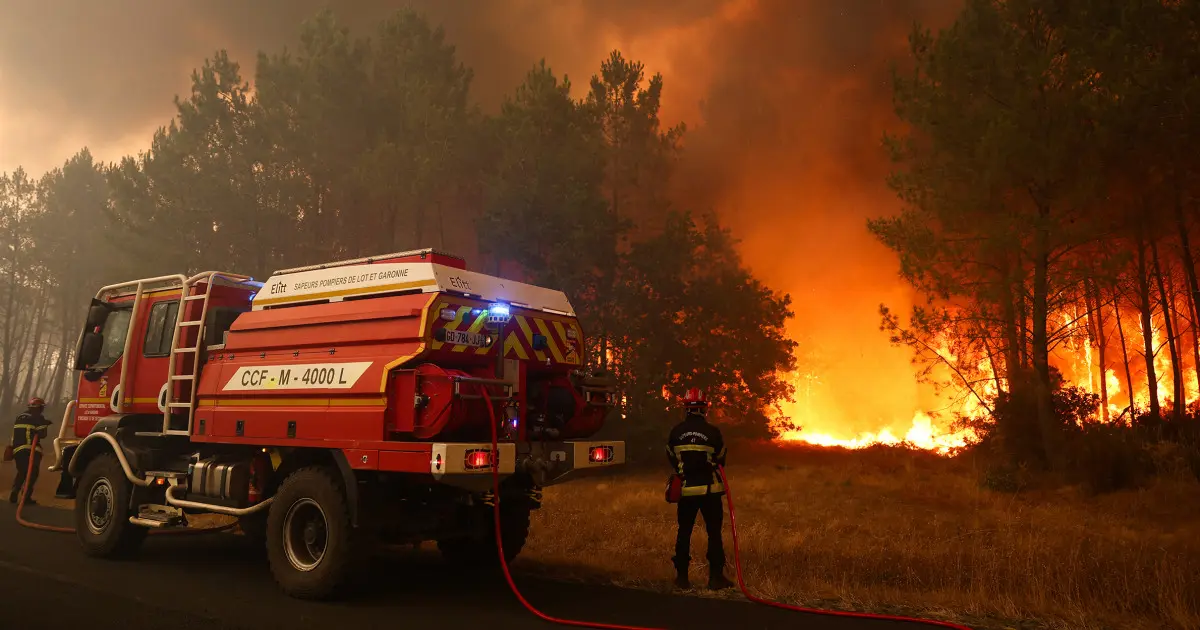
French President Emmanuel Macron visited a coordination center in the southwest of the country on Monday to rally fire crews battling a monster wildfire that has been raging since last week. He described the situation as France's worst fire-related crisis since World War II, urging firefighters to “stay strong” and vowing, “We will win this battle together.”
The blaze, which has been wildly unpredictable, has burned through an area four times the size of Paris. At times, it transformed into a self-feeding firestorm, forcing 220,000 people to flee their homes. Macron praised firefighting teams who managed to stop the inferno's progression on Monday after days of spreading flames that edged toward the wine region city of Bordeaux. However, with woodlands still smoldering and forests turned tinder-dry by successive heat waves, officials cautioned that the battle is not yet won.
Scale of the Crisis
The firefighting effort involved thousands of firefighters on the ground and rotations of water- and retardant-dropping aircraft. It became a race against time to contain the blaze before temperatures soar, with national weather service forecasts of 35°C (95°F) and above in southwest France from Tuesday. Authorities also worked to feed, shelter, and care for evacuees. Macron spoke of displaced people “traumatized” by the upheaval and “who sometimes have lost everything.”
No new evacuations were announced Monday, but with France about to enter its peak August tourist season, authorities for the Gironde region around Bordeaux worked to keep vacationers away. They banned holiday camps for children and for people with disabilities. Government ministers also urged people not to travel to the region, which is popular for its Atlantic beaches, famous wines, and some of France's largest expanses of forests.
Crews using earthmovers tore up strips of forest and scrubland to create barren spaces intended to block the flames. Officials said the fire had come within 10 miles of Bordeaux's outskirts. Farmers kept fire crews supplied with water, transporting it to them in tanks. Briefing Macron, the Gironde region's fire chief explained how crews had wrestled with a blaze unlike any they had previously tackled—extraordinarily virulent and capricious, “a fire that's going everywhere,” which generated electrical storms that sparked more flare-ups.
Macron told firefighters, “The last 24 hours went well, thanks to your work. Doubtless, tomorrow will be more complicated than today.”
Spain and Italy Also Hit by Wildfires
Around a dozen countries have provided planes, helicopters, firefighters, and other assistance to both France and Spain, which is also fighting unprecedented blazes. In Spain, wildfires have burned out of control around Madrid and in the Valencia region. Authorities evacuated 79,000 people and confined 30,000 others to their homes. A fire raging in hilly, rural terrain in Ávila, west of Madrid, has become Spain's largest on record, scorching 195 square miles—five times the size of Barcelona.
David Gonzalez, a 48-year-old gardener who used his van to run supplies to firefighters in Ávila, said, “Look at how the valley is burned. Look at the houses, the people. We are feeling a lot of anger and helplessness. It's something inhuman.”
Fires have burned 590 square miles this year in Spain—six times the area scorched by blazes in the first half of 2025, according to Ecology Minister Sara Aagesen. She warned that another heat wave forecast from Tuesday, which would be Spain's fourth so far this year, could ratchet up the fire danger. Spain's weather agency forecast temperatures above 40°C (104°F).
In Italy, a wildfire driven by strong winds broke out on Sunday afternoon near Peschici in the southern Puglia region. It burned pine forest and scrub and forced the evacuation of about 300 tourists from beaches and campgrounds. The coast guard evacuated tourists by sea to nearby Vieste, where authorities opened temporary shelters. Three Canadair water-bombing planes and fire crews on the ground continued Monday to battle the blaze, which revived memories of devastating wildfires that hit the same coastal area in 2007.
Climate Change Concerns
In both Spain and France, the exceptional scale of the fires—fueled by heat waves that hit especially hard and early this year, making forests and scrubland tinder-dry—is driving calls for stronger action against climate change. Spanish Prime Minister Pedro Sánchez said, “What we are experiencing is not a series of isolated incidents. It is the consequence of a climate emergency that is making wildfires even more violent, heat waves more frequent.”
Scientists have long warned that climate change will increase the frequency and intensity of extreme weather events, including heatwaves and wildfires. Europe has experienced a series of record-breaking heatwaves in recent years, with temperatures surpassing 40°C in many regions. The combination of prolonged drought, high temperatures, and strong winds has created the perfect conditions for devastating wildfires.
The fires in France and Spain have also highlighted the need for better forest management and fire prevention strategies. In some areas, the use of controlled burns to reduce fuel loads and the creation of firebreaks have helped mitigate the spread of wildfires. However, the sheer scale of the current crisis has overwhelmed even the most experienced firefighting teams.
Macron's visit to the Gironde region comes amid mounting pressure on his government to address the impacts of climate change and improve disaster response. The French president has previously committed to increasing funding for firefighting services and investing in climate adaptation measures. However, critics argue that more aggressive action is needed to reduce greenhouse gas emissions and transition to a low-carbon economy.
The wildfires serve as a stark reminder of the immediate threat posed by climate change. As temperatures continue to rise and weather patterns become more erratic, communities across Europe will face an increasing risk of catastrophic wildfires. The response to this crisis—both in terms of firefighting efforts and long-term planning—will be crucial in determining how well countries can adapt to a warming world.
In the meantime, fire crews in France, Spain, and Italy continue to battle the blazes, with thousands of people displaced and hundreds of thousands of hectares of land scorched. The human toll is immense, with many residents losing their homes and livelihoods. The road to recovery will be long and difficult, but the resilience of those affected and the dedication of firefighters provide a glimmer of hope in the face of this unprecedented disaster.
Source: NBC News News