

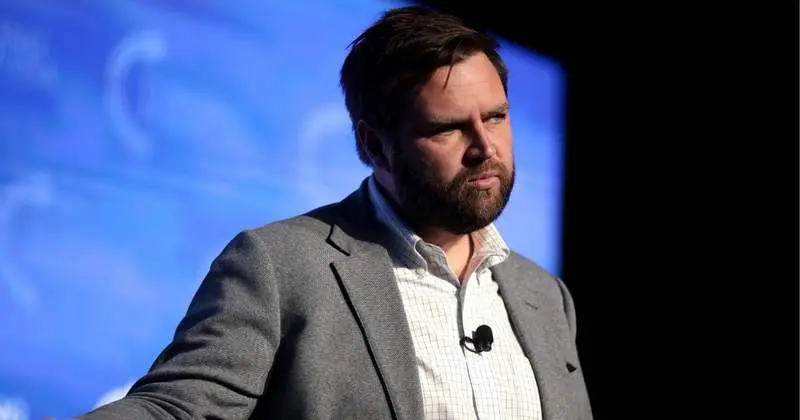
Vice President J.D. Vance said Thursday that he feels "pretty good" about a social media post mocking the weight of Fox News contributor Marc Thiessen, telling radio host Hugh Hewitt that he has no regrets over the remark. The comment came during a call-in appearance on Hewitt's Salem News Channel show, where the two discussed Vance's new book about his conversion to Catholicism before the conversation turned to the conservative media world's latest online clash.
- Vance defended the post as a joke and said he has no regrets.
- The exchange began with a debate over burrito prices and inflation.
- Vance wrote that Thiessen "has never missed a burrito."
- Thiessen has not directly responded to the personal attack.
The controversy began Wednesday when conservative commentator Matt Walsh wrote that rising grocery prices were becoming a political liability for President Donald Trump. Turning Point USA spokesman Andrew Kolvet then posted on X, citing a college student who complained that a burrito should not cost $20. Kolvet attributed the high price partly to pandemic-era conditions and inflation during the Biden administration.
Thiessen replied on X with a skeptical post: "Cry me a river." He added that campus burritos are typically covered under student meal plans, suggesting the student's complaint was overstated. Vance then weighed in with a remark about Thiessen's appearance, writing that "the man has never missed a burrito." The post also misspelled Thiessen's first name as "Mark."
The Trump campaign's X account amplified Vance's post, calling it a "banger." The move signaled that the vice president's allies viewed the jab as effective political communication rather than an embarrassing misstep.
Former Barack Obama speechwriter Jon Favreau criticized the post online and, in a twist, encouraged Vance to keep using the platform. Favreau's comment seemed designed to suggest that the vice president's online behavior could hurt him with voters who expect more dignity from elected leaders.
Commentators across the political spectrum weighed in on the exchange. Some on both the left and right said the remark was unbecoming of a sitting vice president. Others reminded Vance that he has spoken publicly about his own weight struggles, making the attack appear hypocritical.
A Defensive Explanation
Asked directly whether he regretted "taking a punch" at Thiessen, a member of the same Catholic parish, Vance defended the post as an attempt at humor. He said his comment could have been more generous but described Thiessen as a good Catholic. Vance added that Thiessen had treated him unfairly in recent weeks and that he chose to respond in kind.
The vice president invoked the Gospel's account of Jesus' humility, acknowledging that he falls short of that example. However, he said he saw nothing wrong with being "spicy from time to time." He conceded that he might look back on the post differently in two years, but for now, he said, he feels "pretty good about that."
The Backdrop of the Burrito Dispute
The burrito price debate tapped into a broader political fight over inflation and food costs. Republicans have sought to blame the Biden administration for the cumulative price increases that followed the pandemic, while Democrats and the current administration have pointed to supply chain disruptions, corporate pricing practices, and global instability as contributing factors.
Vance's jab was also notable because it came from a vice president who has sometimes tried to appeal to working-class voters by focusing on economic populism. Mocking a Fox News contributor over his weight seemed to cut against that message, at least in the eyes of some critics.
Thiessen has not directly addressed Vance's remark. Instead, he has continued defending his original comments about burrito prices in subsequent posts on X. He argued that college students do not need casual dining options such as Chipotle or Starbucks, suggesting that complaints about expensive burritos ignore the existence of lower-cost meal plans and campus dining halls.
Previous Tensions Between Vance and Thiessen
The burrito exchange was not the first sign of friction between the two conservative figures. Thiessen wrote a column criticizing Vance's public statements on Iran policy, arguing that the vice president was undermining President Trump's position on potential U.S. military action against Iran. Thiessen has voiced support for a more forceful posture toward Iran, while Vance has taken a more cautious public stance on the issue.
The policy disagreement added a layer of context to Vance's personal attack. Rather than engaging Thiessen directly on Iran, Vance chose to respond on a lighter but more personal level. That choice generated significant attention, partly because it exposed a split within conservative circles over both foreign policy and online decorum.
A Pattern of Sharp Social Media Posts
Vance's burrito comment is part of a broader pattern of combative social media behavior. In October 2025, he drew criticism after telling television host Joy Reid on X that she should show more gratitude. In 2021, during a conservative conference appearance, he referred to Democratic vice presidential nominee Kamala Harris as part of a group of "childless cat ladies."
Those remarks have followed Vance as he moved from Senate candidate to vice president. Supporters often view his willingness to attack opponents as refreshing directness, while critics see it as beneath the dignity of high office. The burrito incident underscores the tension between those two interpretations.
Vance's book on his conversion to Catholicism is part of a broader effort to introduce himself to voters who may know little about his personal journey. By discussing his faith on Hewitt's show, Vance attempted to frame his public life around values such as humility and charity. Critics noted that the burrito post seemed to undercut those values, a point Hewitt himself raised during the interview.
The Political Calculus of Online Attacks
The decision by the Trump campaign to repost Vance's burrito comment suggests that the campaign views such attacks as useful. Political operatives often believe that aggressive online posts energize the base and generate media coverage. In this case, the coverage was not entirely favorable, but it did keep Vance in the news cycle during a period when the administration was eager to change the subject from inflation.
There is also a risk that personal attacks can overshadow policy messages. When a vice president mocks a commentator's weight, the debate over burrito prices becomes about the vice president's tone rather than the underlying economic issue. That dynamic may explain why some conservatives, even those who agree with Vance on policy, were uncomfortable with the post.
Thiessen's silence on the personal attack is notable. By refusing to engage with Vance's jab, Thiessen may be trying to deny it further oxygen. At the same time, his continued focus on burrito prices suggests he wants the debate to stay on policy rather than personality.
The Role of Faith in Vance's Public Defense
Vance's decision to cite the Gospel in defending his remark was significant. He acknowledged that Jesus embodied humility and that he falls short of that ideal. Yet he also suggested that being "spicy from time to time" is not inconsistent with his faith. That defense has drawn mixed reactions from religious conservatives, some of whom believe that public officials should hold themselves to a higher standard, while others appreciate a leader who does not back down from critics.
The broader cultural moment has made such debates increasingly common. Social media rewards
Source: AOL.com News