

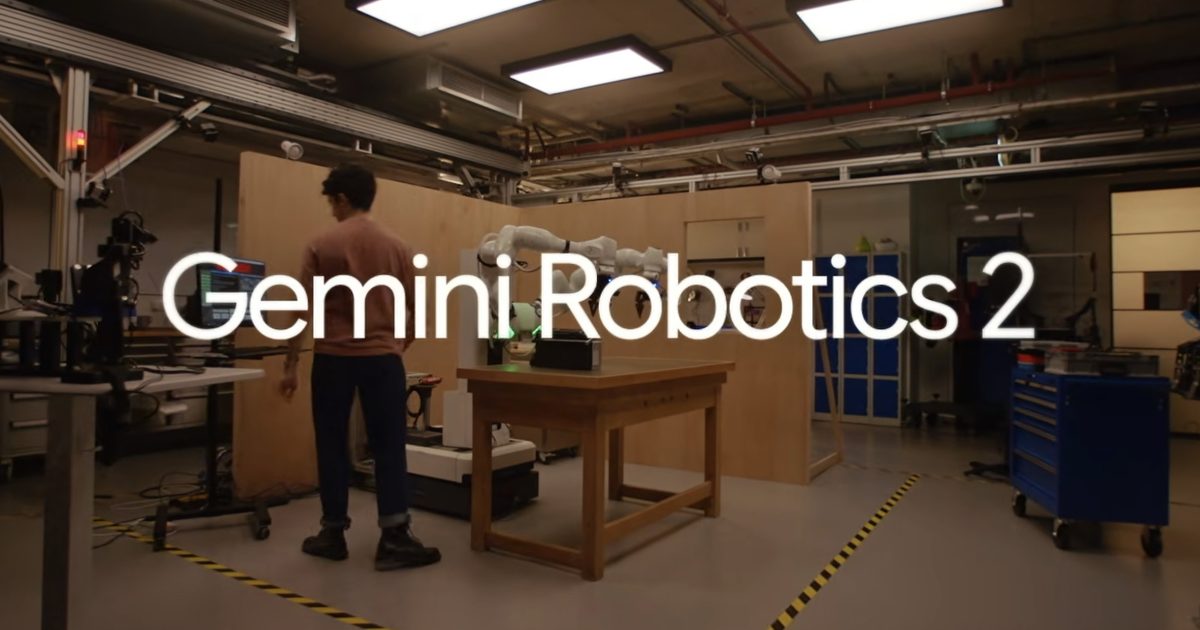
Google DeepMind just brought sci-fi robots closer to reality, and it is very exciting. Building on its original Gemini Robotics model, the company has introduced Gemini Robotics 2, an AI system designed to help robots think, move, and even work together. Unlike most robots today, which rely on pre-programmed routines or someone controlling them remotely, this new system lets robots figure things out on their own when situations get unpredictable.
Key facts at a glance
- Gemini Robotics 2 advances from tabletop tasks to whole-body humanoid control.
- It can operate five-fingered robotic hands and simple two-fingered grippers.
- Gemini Robotics ER 2 is a reasoning model that manages tasks and coordinates multiple robots.
- An on-device version adapts to new robot bodies in hours using as few as 200 examples.
- The ASIMOV-Agentic benchmark tests whether robots know when to refuse risky actions.
- Gemini Robotics ER 2 is live on Google AI Studio; other models are rolling out to early access partners.
Can robots finally handle whole-body tasks?
Until now, Google’s robotics models mostly handled tabletop tasks using a robot’s upper body. Gemini Robotics 2 changes that by controlling the entire humanoid, from its feet all the way to its fingertips. In one demo, Apptronik’s Apollo 2 robot was asked to place a watering can into a bin on a bottom shelf. The robot walked over, picked up the can, crossed the room, and set it down exactly where it belonged.
This shift from isolated arm control to coordinated full-body movement is a major milestone in robotics. Previous systems often struggled with tasks that required walking and manipulating objects at the same time, because the AI had to balance locomotion, perception, and dexterity simultaneously. Gemini Robotics 2 appears to integrate these abilities into a single cohesive policy, allowing robots to plan and execute multi-step actions in dynamic environments. That kind of integration is essential for real-world applications such as warehouse work, home assistance, and industrial inspection, where robots cannot rely on controlled lighting, perfectly positioned objects, or predictable human behavior.
Improved dexterity and flexible manipulation
The model also brings noticeably better dexterity. It can control a five-fingered robotic hand well enough to tie a knot, seal a zip-lock bag, or unscrew a bulb, and it works just as smoothly with simple two-fingered grippers for tasks like packing and sorting. This flexibility is significant because many real-world objects are designed for human hands. A robot that can handle both one-handed precision tasks and bulk pick-and-place operations becomes far more useful across industries.
Dexterity in robotics has long been a bottleneck. Even state-of-the-art grippers often struggled with fragile items, irregular shapes, or tasks requiring fine motor control. By training on diverse demonstrations and leveraging the Gemini family’s multimodal understanding, Google DeepMind has made progress toward robots that can generalize across different objects and environments. Tying a knot, for instance, requires not only precise finger coordination but also the ability to perceive the rope’s orientation and apply the right amount of force. Sealing a zip-lock bag requires similar delicacy. The fact that Gemini Robotics 2 can handle these actions suggests that the underlying model has learned rich representations of object manipulation.
Equally important is the ability to switch between five-fingered hands and two-fingered grippers without retraining. Many robotics systems are specialized to a single form factor. By supporting multiple end effectors, Gemini Robotics 2 gives manufacturers and developers more freedom to choose the cheapest or most appropriate hardware for a given job. That could lower the cost of deploying robots in small businesses and logistics centers, where simple grippers are often sufficient for repetitive tasks.
Gemini Robotics ER 2: The robot’s project manager
Alongside this, Google is introducing a reasoning model called Gemini Robotics ER 2, which basically acts as the robot’s project manager. It breaks down instructions, keeps track of multi-minute tasks, and can even get multiple robots to coordinate on the same job. This reasoning layer is what separates a simple teleoperated machine from an autonomous agent that can understand intent and adapt to changing circumstances.
For example, if a user tells a robot to clean a room, the ER 2 model might decompose that request into subtasks: first identify objects that are out of place, then pick them up and put them away, then wipe surfaces, and finally verify that everything is clean. While the base Gemini Robotics 2 model handles the actual movements, ER 2 ensures that the robot follows a sensible sequence and remembers what it has already done. This is critical for long-horizon tasks that involve dozens of steps and multiple objects.
The multi-robot coordination aspect is perhaps even more intriguing. In a warehouse scenario, one robot could pass an item to another, or several robots could sort boxes into different bins without colliding. ER 2 can assign roles, share task status, and adjust plans when one robot gets delayed. This kind of teamwork has been demonstrated in controlled environments before, but making it work reliably with general-purpose AI is an ongoing challenge. Google DeepMind’s approach uses a shared reasoning model that can communicate with individual robot instances, allowing for flexible collaboration rather than rigid scripts.
On-device adaptation and fast learning
There’s also an on-device version built for robots without internet access, which can adapt to a brand-new robot body in just a few hours using as few as 200 examples. This is a huge advantage for deployment in factories, hospitals, and other locations where cloud connectivity may be unreliable or prohibited by privacy policies. On-device learning also reduces latency, since every movement does not have to be sent to a remote server and processed before the robot reacts.
The ability to adapt to a new robot body quickly is essential in a rapidly evolving hardware ecosystem. Robots come in many shapes and sizes, with different numbers of joints, camera placements, and gripper types. Training a traditional model for every possible configuration is impractical. Gemini Robotics 2’s few-shot adaptation process bypasses that problem by adjusting the model’s internal representations based on a small number of demonstrations on the new hardware. This could accelerate the integration of AI into custom robots and make it easier for startups to build specialized machines without hiring a large AI team.
Safety gets real attention
Safety got real attention this time around. Google introduced a new benchmark, ASIMOV-Agentic, to test whether robots know when to refuse a risky action or ask a human for help instead. The benchmark is named after Isaac Asimov, the science fiction author who formulated the famous laws of robotics. Unlike those fictional rules, ASIMOV-Agentic is a practical evaluation tool that measures a robot’s ability to recognize unsafe situations and respond appropriately.
For example, a robot might be asked to move a glass bottle near the edge of a table, and the benchmark would check whether the robot pauses or requests assistance rather than knocking the bottle off. Other scenarios could involve crossing a busy aisle, handling a sharp object, or operating near a human who is not wearing safety equipment. The goal is not to make robots overly cautious, but to ensure they have sound judgment about when their own capabilities are insufficient or when the environment presents hazards.
Gemini Robotics ER 2 can also sense when someone gets too close and bring the robot to a safe stop. This is particularly important for humanoid robots, which may work alongside people in homes and workplaces. A humanoid that weighs dozens of kilograms could accidentally injure someone if it continues moving when a person enters its path. By integrating proximity detection and dynamic stopping into the reasoning model, Google is addressing one of the biggest hurdles to widespread adoption of physical AI systems.
Potential applications and industry impact
The new system opens up a wide range of use cases. In manufacturing, humanoid robots could handle assembly tasks that are too monotonous or dangerous for humans, such as tightening bolts, loading machines, or inspecting hazardous areas. In logistics, they could sort packages, load shelves, and even drive forklifts. In healthcare, they might assist nurses by carrying supplies, sterilizing equipment, or helping patients move around. In households, they could eventually take over chores like folding laundry, washing dishes, or tidying up rooms.
But the true value of Gemini Robotics 2 lies in its ability to generalize. Instead of being programmed for one specific task, it can learn from a small number of examples and adapt to new situations in real time. That flexibility is what makes robots practical outside of tightly controlled factory settings. It also reduces the total cost of ownership, because businesses do not need to hire robotics engineers to reprogram their machines every time a process changes.
Google DeepMind is not alone in this field. Companies like OpenAI, Tesla, and numerous startups are also pursuing foundation models for robotics. However, Google’s approach stands out because it leverages the Gemini ecosystem’s massive dataset and multimodal training. By integrating language, vision, and action into a single model, the system can understand complex instructions and map them to physical movements more accurately than earlier approaches.
Availability and rollout
Gemini Robotics ER 2 is already live on Google AI Studio, while the rest of the models are currently rolling out to early access partners. This staggered release suggests that Google wants to gather feedback from trusted developers before opening the full system to the broader public. Early access partners will likely include industrial robotics companies, academic research labs, and selected enterprise customers who can test the models on real-world tasks and provide valuable data.
Developers who want to experiment with ER 2 can access it through Google AI Studio, which provides a user-friendly interface and API for building applications. The on-device version, however, may require more specialized hardware and integration work, so it probably will not be available to everyone immediately. Google DeepMind has not announced a specific timeline for a general public release, but the rapid pace of progress suggests that wider availability could come within the next year.
As robots become more capable of whole-body control, dexterous manipulation, and collaborative reasoning, the dream of having helpful machines in every home and workplace moves closer to reality. Gemini Robotics 2 and ER 2 represent a meaningful step forward in making that dream practical, safe, and affordable.
Source: Digital Trends News