

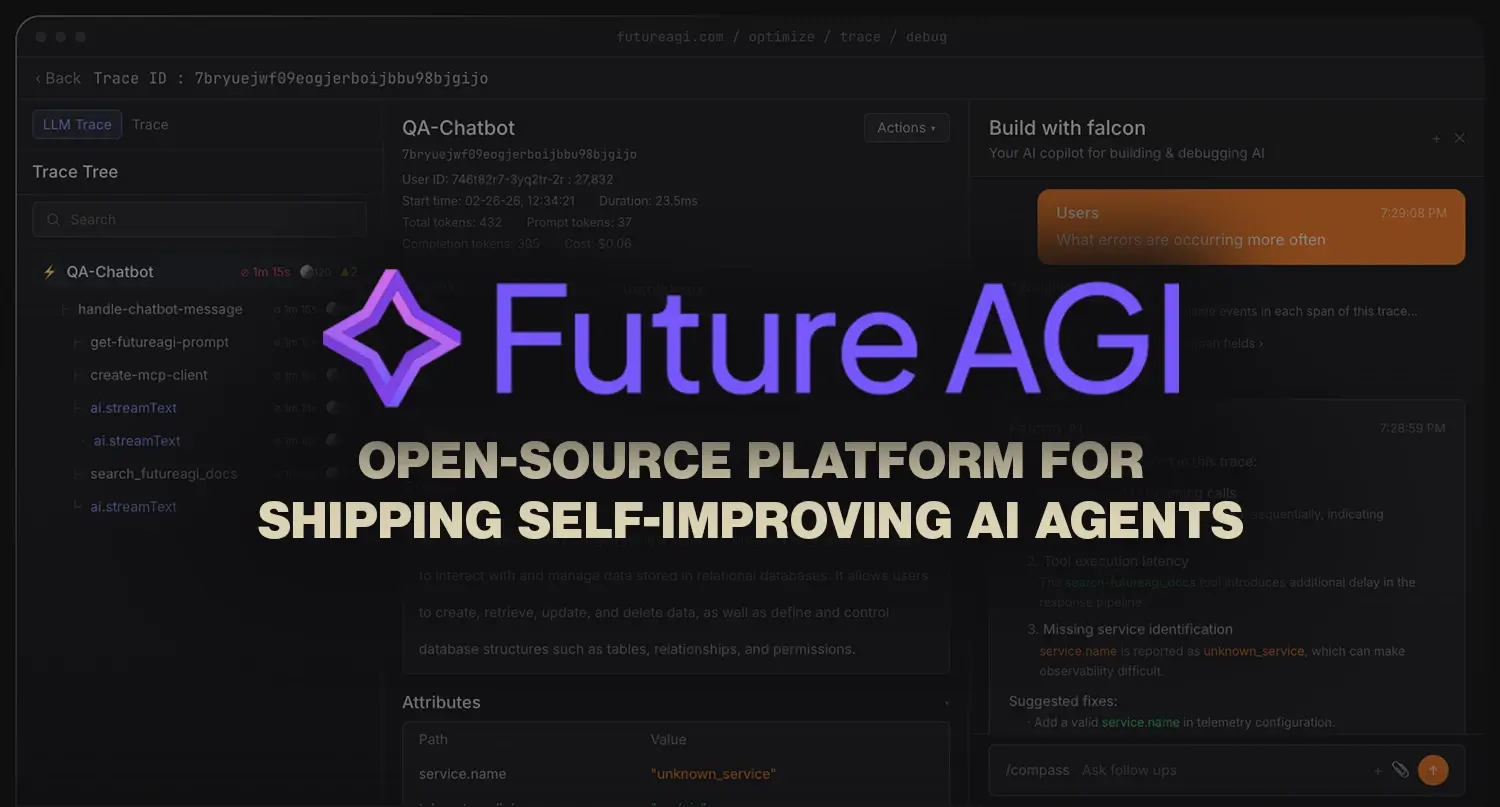
Future AGI has emerged as an open-source platform designed to help engineering teams trace, evaluate, simulate, and guardrail LLM agents throughout the development lifecycle. The project is licensed under Apache 2.0 and can be self-hosted, making it an attractive option for organizations that want to keep sensitive data and model traffic inside their own infrastructure. The platform combines an instrumentation layer, a unified gateway, and a set of security scanners built for the unpredictable behavior of autonomous AI agents.
At a time when AI agents are moving from simple chat assistants to systems that can plan, use tools, and act on behalf of users, the need for observability and safety controls has become central. Future AGI addresses this by providing a control plane that sits in front of models and agent frameworks. It gives developers a unified view of agent behavior and a way to enforce policies before, during, and after execution.
Key facts at a glance
- Future AGI is open-source and licensed under Apache 2.0.
- It supports tracing, evaluation, simulation, and guardrailing for LLM agents.
- The project is self-hostable and supports air-gapped and on-prem deployments.
- Telemetry is enabled by default but can be disabled with FUTURE_AGI_TELEMETRY_DISABLED=1 before first boot.
- Instrumentation covers more than 50 agent frameworks via OpenTelemetry, including LangChain, LlamaIndex, CrewAI, and DSPy.
- The Agent Command Center is an OpenAI-compatible proxy that fronts more than 100 providers.
- Protect includes 18 built-in scanners for PII, jailbreak, and prompt injection, plus adapters for Lakera, Presidio, and Llama Guard.
- Inline scanning maintains P99 latency at or under 21 ms in the project benchmark harness.
Telemetry and privacy by design
One of the most important details in the platform documentation is how self-hosted instances handle registration. On first boot, a self-hosted instance sends an instance ID, a version string, a deployment type, and the email addresses and domains of active admin users to Future AGI servers. This registration happens only once, before anyone signs in to the dashboard.
The telemetry behavior is controlled with a single environment variable: FUTURE_AGI_TELEMETRY_DISABLED=1. This variable must be placed in the .env file before the first start. If administrators miss that window, the instance will already have shared the admin list with the network. The project documentation describes air-gapped and on-prem deployment as supported and phone-home free, but with an important nuance: disabling telemetry does not eliminate all communication. A single census ping with instance ID, version, and deployment type still goes out, while email addresses are withheld. Periodic heartbeats stop. For operators who need full silence, the recommended approach is to turn off networking at the edge.
This design highlights a broader question around open-source software and default telemetry. Many popular developer tools have moved to phone-home analytics to understand usage patterns, but not all of them give users a clear pre-boot off switch. Future AGI approach is more transparent than most, yet it still demands careful reading. The phrase before first boot appears repeatedly because the registration mechanism is not designed to wait for user consent. The system assumes that installing the platform is consent, unless the environment variable is set in advance.
What the installation includes
The installer sets up a local stack with ClickHouse, PostgreSQL, Redis, RabbitMQ, and Temporal behind a dashboard on localhost:3000. Each component plays a specific role. ClickHouse is a column-oriented database designed for fast analytical queries, and it is where spans land. Prompt text, model output, and tool calls pass through the tracer on the way into that store. PostgreSQL handles relational metadata, Redis provides caching and message brokering support, RabbitMQ manages queue-based workflows, and Temporal enables durable orchestration of long-running agent tasks.
The use of Temporal is particularly relevant for AI agents. Agents often need to wait for human input, external tool responses, or scheduled jobs. Temporal gives developers a way to make those workflows fault-tolerant and observable. If an agent crashes mid-task, the workflow can be resumed from the last completed step rather than starting over. This is an important feature for production-grade agent pipelines.
Observability for complex agent ecosystems
Future AGI instrumentation layer is built on OpenTelemetry, the open standard for telemetry data. It covers more than 50 agent frameworks, including LangChain, LlamaIndex, CrewAI, and DSPy. This breadth means engineers do not need to replace their existing agent construction stack. They can add Future AGI as a tracing and evaluation layer on top of the frameworks they already use.
The tracer captures the full lifecycle of an agent run: the original prompt, the model output, any tool calls, and the final response. That data is stored in ClickHouse, where it can be queried, compared, and used to build evaluation datasets. Because traces are stored centrally, teams can identify patterns of failure, latency bottlenecks, and unintended behavior across many different agents and models.
A subtle architectural point is that the defender inherits access controls on the database along with the traces. This means security policies are not bolted on after the fact; they are tied to the same data plane. If an organization can control who has access to ClickHouse, it can control who has access to the traces and by extension the security posture of the deployment.
The Agent Command Center gateway
The Agent Command Center is an OpenAI-compatible proxy that sits in front of more than 100 providers. It supports multiple routing strategies, semantic caching, virtual keys, MCP, and A2A. The gateway is designed to be a single termination point for every provider credential in a deployment. Instead of scattering API keys across agents and services, teams can centralize them behind one proxy and apply policy uniformly.
OpenAI compatibility is a deliberate choice. Because many developer tools and frameworks already support the OpenAI API format, an OpenAI-compatible proxy can be used as a drop-in replacement for the base URL. That makes it much easier to adopt Future AGI without rewriting every agent. The proxy also enables advanced routing, such as sending certain requests to cheaper models, larger models, or on-premise models based on context, cost, or reliability requirements.
Semantic caching is another useful feature. Instead of caching only exact prompt strings, semantic caching compares vectors or embeddings of incoming prompts to find similar queries. This can reduce latency and cost by avoiding repeated calls to expensive models. Virtual keys give each project or team its own API key while still using a single upstream provider account. That makes it easier to track usage, enforce budget limits, and revoke access when a key is compromised.
The protocol support for MCP and A2A reflects the growing importance of agent-to-agent communication. MCP, or Model Context Protocol, is an open standard for connecting models to tools and data sources. A2A, or Agent-to-Agent, is a newer protocol for enabling agents to discover and communicate with each other. By supporting both, Future AGI positions itself as an infrastructure layer for the emerging agent ecosystem, not just a single-agent debugger.
Security scanners and inline protection
Protect, the safety engine inside Future AGI, ships with 18 built-in scanners. These cover categories such as personally identifiable information, jailbreak attempts, and prompt injection. In addition to the built-in scanners, the platform includes vendor adapters for Lakera, Presidio, and Llama Guard. This allows teams to plug in external security services if they already have a preferred vendor or need specialized detection models.
The scanners can run inline in the gateway or standalone through the SDK. Inline scanning is the more common pattern for production environments because it applies policy at the moment a request arrives. The project benchmark harness reports that inline scanning holds P99 latency at or under 21 milliseconds. For most LLM applications, where model inference itself can take hundreds or thousands of milliseconds, adding 21 milliseconds is a small price for safety. Still, the team appears to have optimized the scanners to keep overhead low, which is essential for user-facing AI products.
Prompt injection is a particularly difficult problem because agents are trained to follow instructions, and an injected instruction can override the system prompt. Guardrailing platforms need to detect malicious instructions without creating too many false positives. The inclusion of vendor adapters suggests Future AGI is built to be flexible: teams can start with the built-in scanners and later add a specialized vendor if they need stronger detection.
Supporting self-improving AI agents
The title of the project, Future AGI, reflects an ambition to support agents that can improve themselves. The platform enables this through simulation, evaluation, and guardrailing. Simulation lets teams run agents in controlled environments before deploying them. Evaluation lets them measure performance against benchmarks and custom datasets. Guardrailing limits the actions an agent can take in production.
These three capabilities are essential for any system that wants to be safely self-improving. An agent that can rewrite its own prompts or select its own tools needs a feedback loop. Future AGI tracing infrastructure provides that loop by recording everything an agent does, so a developer can see what changed, why it changed, and whether the change improved outcomes. Evaluation stops the loop from running uncontrolled. Baseline tests ensure that new prompts, new models, or new agent frameworks do not degrade performance. Guardrailing ensures that even if an agent behaves unexpectedly, it cannot harm the user or leak data.
The phrase self-improving can be misleading. In practice, most self-improvement still requires a human in the loop or a closed-loop evaluation system. Future AGI provides the substrate for building such a loop, but it does not promise an autonomous AGI. Instead, it gives engineers the means to make agents more reliable over time by collecting high-quality telemetry and applying safety checks.
Why this matters for AI engineering
The open-source nature of Future AGI is significant. Many AI observability platforms are commercial services that require sending traces to a cloud provider. Governments, financial institutions, healthcare organizations, and defense contractors often cannot do that because of data protection regulations. A self-hosted, Apache-2.0 licensed platform gives those organizations the ability to gain visibility into their own AI systems without exposing sensitive content to a third party.
The telemetry registration is a reminder that open-source projects still need some way to understand their installed base. The team behind Future AGI made a pragmatic choice: collect lightweight information, document the behavior, and allow a simple opt-out. That is more transparent than many commercial tools, but administrators must be aware of the exact sequence of events. The registration fires before first login, so the decision to disable telemetry has to be made at installation time.
Future AGI product breadth is also notable. Many observability tools focus only on tracing, or only on gateway routing, or only on security scanning. Future AGI combines all three in one package. That convergence aligns with the market trend toward unified platforms. Teams face too many moving parts in agent stacks; reducing the number of tools is often more valuable than adding another point solution. Future AGI is available for free on GitHub, making it possible for any team to experiment with a full agent observability and safety stack without upfront licensing costs.
Source: Help Net Security News