

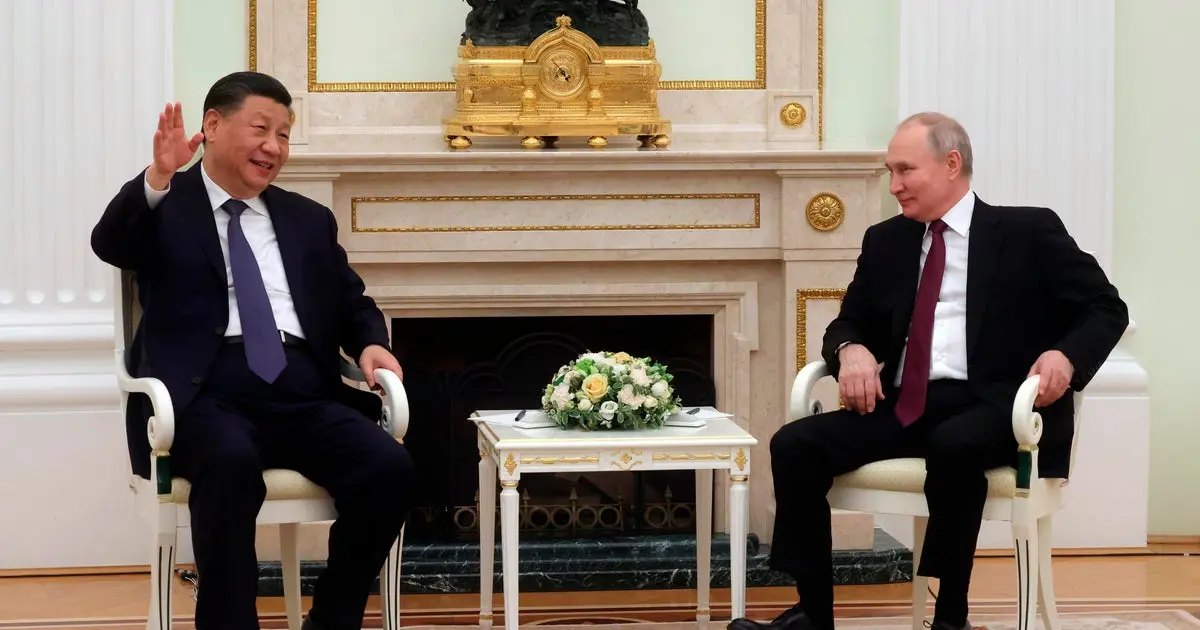
Russian President Vladimir Putin will meet with Chinese leader Xi Jinping on a two-day trip to Beijing next week, the Kremlin said Saturday. The meeting, scheduled for May 19-20, marks the 25th anniversary of the 2001 Sino-Russian Treaty of Friendship and comes less than 24 hours after U.S. President Donald Trump concluded his own state visit to China, where he met with Xi to discuss trade and the war in Iran.
During the meeting, Xi and Putin will discuss bilateral relations, economic cooperation, and "key international and regional issues," the Kremlin said. The Russian government added that following the talks, a joint statement "at the highest level" and several bilateral intergovernmental, interdepartmental, and other documents are expected to be signed.
Putin's trip to Beijing underscores the deepening ties between China and Russia, which have grown significantly since the start of Russia's full-scale invasion of Ukraine in early 2022. Western sanctions have effectively isolated Moscow from much of the global economy, leaving it heavily reliant on Beijing for trade, investment, and diplomatic support. In return, China has positioned itself as a neutral party while providing economic lifelines to Russia, including increased energy imports and technology transfers that help sustain its war efforts.
Trump's Visit: A Contrast in Outcomes
Trump's state visit to China, which ended just hours before the Kremlin's announcement, was marked by warm rhetoric but produced few concrete results. Trump touted the success of the trip, claiming that Chinese officials opened the door to new areas of cooperation with the U.S. On Saturday, Trump posted two photos of himself and Xi on Truth Social, praising Xi as "a Leader who is respected by all." One image shows the two leaders walking on a red carpet in front of saluting service members, while the other captures them shaking hands.
Despite these positive gestures, many analysts and former U.S. officials expressed skepticism. Wendy Cutler, a former negotiator in the Office of the U.S. Trade Representative, told CBS News that "so far, it doesn't seem like Trump and his team have a lot to show for the visit." No major trade deals were announced, and questions remain about the future of U.S. economic engagement with China. The most significant unresolved issue is the $14 billion arms sale to Taiwan, which Congress approved in January but Trump has yet to move forward with. Both Democratic and Republican leaders have urged Trump to support the sale, which is seen as a key component of U.S. commitments to the island territory's self-defense.
Trump's failure to deliver breakthrough trade deals during the trip highlights the challenges of negotiating with China, which has increasingly leveraged its economic power and political stability to resist foreign pressure. The visit also did little to ease tensions over trade tariffs, intellectual property theft, and the ongoing tech competition between the two superpowers.
The China-Russia Axis: Strengthening Bonds
Relations between China and Russia have deepened substantially over the past few years, driven by shared opposition to U.S. hegemony and a mutual need for strategic partners. The Sino-Russian Treaty of Friendship, signed in 2001, laid the foundation for a partnership that has evolved into a comprehensive strategic alliance. The upcoming meeting will mark the 25th anniversary of this treaty, a milestone that both sides are expected to celebrate with the signing of multiple documents.
When Putin last visited China in September 2025, Xi welcomed him as an "old friend," and Putin reciprocated by addressing Xi as "dear friend." These personal bonds reflect the close working relationship between the two leaders, who have met dozens of times over the years. Their cooperation extends beyond bilateral trade to include coordination on international forums such as the United Nations, the Shanghai Cooperation Organization, and the BRICS grouping.
Chinese support has been critical for Russia's economy during the Ukraine war. China has become Russia's largest trading partner, with bilateral trade reaching record levels in 2024. Chinese imports of Russian oil, gas, and coal have helped offset the impact of Western energy sanctions, while Chinese exports of electronics, machinery, and consumer goods have filled gaps left by European and American companies that withdrew from Russia. In addition, China has provided Russia with dual-use technologies that can be used for both civilian and military purposes, although Beijing officially maintains a neutral stance on the war.
The deepening Sino-Russian partnership has also manifested in joint military exercises and strategic arms control dialogues. In recent years, the two countries have conducted naval drills in the South China Sea and the Sea of Japan, and their air forces have conducted joint patrols over the Pacific. These activities are often framed as responses to U.S. alliances in the region, such as the Quad and AUKUS.
Geopolitical Implications of the Upcoming Summit
The timing of Putin's visit—immediately after Trump's—sends a clear signal that China is pursuing a balanced but increasingly pro-Russian foreign policy. While Beijing continues to engage with Washington on trade and climate issues, it has shown no willingness to distance itself from Moscow. The joint statement expected from the Xi-Putin meeting is likely to reaffirm their commitment to a multipolar world order and criticize U.S. unilateralism.
Key issues on the agenda include economic cooperation in areas such as energy, infrastructure, and technology. Both countries are working to reduce their reliance on the U.S. dollar in bilateral trade, promoting the use of their own currencies—the yuan and the ruble—for settlements. They are also collaborating on the development of the Arctic shipping route and jointly investing in infrastructure projects in Central Asia under the Belt and Road Initiative.
Regional security is another critical topic. China has expressed concern about U.S. activities in the Taiwan Strait and the South China Sea, while Russia seeks Chinese support for its stance on NATO expansion and the Ukraine conflict. The two countries are expected to coordinate their positions on these issues ahead of the next G20 summit and the Asia-Pacific Economic Cooperation (APEC) forum in Shenzhen, which Putin is scheduled to attend in November.
The meeting also comes amid growing uncertainty about U.S. foreign policy under Trump, who has signaled a desire to reduce American commitments overseas. Some analysts believe that Trump's transactional approach to diplomacy has inadvertently pushed China and Russia closer together, as both capitals view the U.S. as an unreliable partner. This trend is likely to continue regardless of who occupies the White House, given the structural drivers of Sino-Russian alignment.
In the broader context, the Xi-Putin meeting is a reminder that China and Russia are building a strategic partnership that could reshape global governance. Their cooperation extends to the United Nations Security Council, where they often vote together on resolutions related to Syria, Venezuela, and Ukraine. They have also jointly promoted alternative international institutions such as the Asian Infrastructure Investment Bank and the New Development Bank.
As the world watches the two leaders meet in Beijing, the outcome of their talks will have significant implications for the balance of power between the United States, China, and Russia. For now, the deepening alliance between the world's two largest land powers shows no signs of slowing down, even as the United States attempts to rebuild its own alliances with traditional partners in Europe and Asia.
Putin's visit will also be an opportunity to showcase the personal rapport between the two leaders, which has been a cornerstone of the relationship. Xi and Putin have met more than 40 times since Xi became president in 2013, and their interactions are often characterized by mutual respect and a shared understanding of global affairs. This personal chemistry has helped smooth over differences on issues such as Russian arms sales to India and Chinese investment in Russia's Far East.
The upcoming summit will focus on concrete deliverables, including agreements on energy infrastructure, space cooperation, and scientific research. Both sides are expected to announce new collaborative projects in the Arctic and along the Polar Silk Road, as well as next steps for the Power of Siberia 2 pipeline, which would increase Russian natural gas exports to China. These projects are crucial for Russia, which is seeking new markets for its energy resources after losing much of its European customer base.
For China, the deepening partnership with Russia provides access to natural resources and technological expertise that can bolster its economic growth and energy security. Chinese companies are increasingly involved in Russian oil and gas fields, and Chinese banks have become important sources of financing for Russian infrastructure projects.
Finally, the meeting will reaffirm the commitment of both countries to a multipolar world order, in which no single power dominates international affairs. This vision stands in stark contrast to U.S. efforts to maintain global leadership and promote democratic values. As the rivalry between the United States and the China-Russia axis intensifies, the world can expect to see more frequent high-level meetings and deeper integration between Beijing and Moscow.
Source: Cbsnews News