

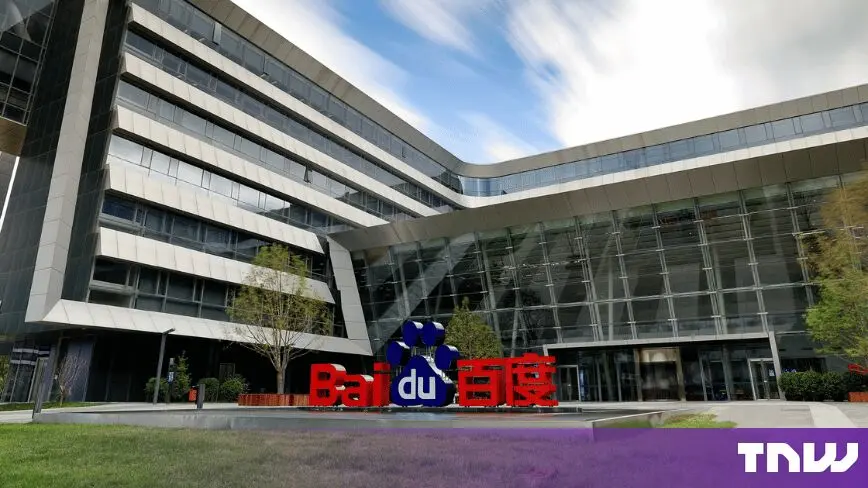
Baidu's revenue decline extended to a fifth consecutive quarter, as the company's booming AI cloud business failed to keep pace with the accelerating drop in its core advertising market. The Chinese search and artificial intelligence giant reported second-quarter revenue of RMB31.3 billion ($4.62 billion), down 4 percent from the same period last year and 2 percent from the previous quarter.
Net income attributable to Baidu was RMB2.3 billion ($342 million), a steep fall from RMB7.3 billion a year earlier. Analysts widely interpreted this as a 68 percent year-over-year decline. The weaker-than-expected earnings triggered a sell-off in the company's US-listed shares, which dropped as much as 10 percent to $93.70 in early trading before paring some losses.
The revenue figure also missed consensus forecasts. Analysts polled by financial data providers had expected revenue in the range of RMB31.6 billion to RMB31.96 billion. Baidu's actual result fell short of both estimates, underscoring the challenges facing the company as it transitions from a search-driven business to an AI-centric one.
The Two Halves of Baidu Are Pulling Apart
The clearest illustration of Baidu's predicament lies in the divergent performance of its two main business lines. Online marketing, the company's traditional mainstay, generated RMB13.1 billion in revenue, a 19 percent year-on-year decline. The drop was attributed to a weak Chinese property sector and cautious consumer spending, both of which have prompted companies to slash marketing budgets.
Meanwhile, Baidu's AI-powered businesses are growing rapidly from a smaller base. The Core AI-powered Business segment brought in RMB12.5 billion in revenue, up 25 percent year-on-year, and now accounts for half of the company's general business revenue. Within this segment, AI Cloud Infra revenue rose 50 percent to RMB7.3 billion.
The most striking number was GPU Cloud, which rents out AI accelerators to enterprises and developers. Its revenue surged 283 percent year-on-year, accelerating from 184 percent growth in the previous quarter. Baidu renamed this revenue line in the current quarter—it had previously been described as subscription revenue from AI accelerator infrastructure. The company said the growth reflects mounting demand for public cloud AI computing power as Chinese tech firms race to build and deploy large language models.
Baidu restructured its financial reporting late last year to break out AI businesses into a standalone segment, spanning cloud services, applications, and marketing. That segment surpassed half of Baidu's core sales for the first time in the March quarter, and it held roughly steady at that level in the June quarter.
Ernie Has Fallen Behind, and the CEO Knows It
While Baidu's AI infrastructure business is thriving, its in-house large language model, Ernie, has lost its competitive edge. Ernie has gone months without a major upgrade, even as rivals have shipped newer and more capable models. Industry observers note that Ernie now trails open-weight models such as Moonshot AI's Kimi series, which have achieved performance on key benchmarks comparable to OpenAI and Anthropic's leading systems.
Chief executive Robin Li acknowledged the challenge and made regaining lost ground the central theme of his remarks to analysts. He said Baidu would return Ernie to the frontier of AI development. “In a market like this, we believe long-term competitiveness ultimately comes down to sustained technology investment, application-driven approach, and patience,” Li said.
The competitive pressure is intense. Alibaba's Qwen model has been steadily closing the gap with Moonshot in raw capability. Moonshot, in turn, trained its latest Kimi K3 model using 20,000 Nvidia chips rented through Alibaba's cloud infrastructure. This illustrates how Baidu's rivals are leveraging both their own AI models and the vast computing resources of Chinese cloud providers to push the frontier forward.
The AI Bet Is Expensive
Winning in AI requires heavy upfront investment. Excluding its streaming unit iQIYI, Baidu's capital expenditure tripled in the quarter to RMB11.4 billion, up from RMB3.78 billion a year earlier. This spending on chips and data centres is expected to continue pressuring profit margins, even as AI revenue climbs.
Baidu is not alone in this squeeze. Tencent, its larger rival, reported this month that its AI compute bill had outgrown its cash flow—the same pattern of heavy upfront spending on models that have yet to deliver full financial returns. The entire Chinese tech industry is engaged in an AI arms race, and the cost of computing power from Nvidia and domestic alternatives remains steep.
Baidu's cash position remains substantial, however. The company reported RMB283.1 billion ($41.72 billion) in total cash and investments, along with operating cash flow of RMB3.4 billion—positive for a fourth consecutive quarter. It has also returned $259 million to shareholders through buybacks since the start of the year, under a programme initiated alongside its first-ever dividend in February.
Robotaxis and a Hong Kong Listing
Beyond software and cloud services, Baidu is doubling down on autonomous driving. Its Apollo Go robotaxi service has expanded to 28 cities and logged more than 350 million autonomous kilometres, of which over 240 million were fully driverless. The company recently began open-road testing in London with Uber and Lyft, launched driverless commercial rides in Dubai, and won Hong Kong's first fully driverless testing permits.
That international push follows a setback at home. A fleet outage in Wuhan in April triggered an industry-wide safety review and a three-month freeze on new robotaxi permits. Chinese regulators have since resumed issuing permits, allowing Baidu to restart its expansion within the country. The company also secured a Level 4 autonomous driving clearance in Switzerland in June, further bolstering its international credentials.
On the corporate front, Baidu said its dual-primary listing in Hong Kong should take effect this year, giving mainland investors direct access to its shares. The company is also spinning off its chip unit Kunlunxin, which is eyeing a Hong Kong listing to tap into demand for domestic alternatives to Nvidia processors.
Baidu is casting this entire strategic shift as a change of identity. Chief financial officer Haijian He emphasized that operating cash flow remained positive for the fourth consecutive quarter and that the company is committed to investing in AI as its core growth driver. The company's flagship Baidu App still reached 644 million monthly active users in June, providing a massive installed base into which AI features can be sold.
Whether the Pivot Pays Is Unproven
Not every analyst is convinced that Baidu's AI push can carry the company forward. Bloomberg Intelligence's Robert Lea wrote that the company's prospects hinge on turning money-losing AI businesses profitable. Lea expressed doubt about Baidu's ability to achieve this, citing its lack of scale compared to China's largest platforms like Alibaba and Tencent.
The coming quarters will determine whether the AI bet pays off. Three key metrics will settle the question. First, whether AI Cloud growth can outpace the advertising decline in absolute terms, not just in percentage growth rates. Second, whether the tripled capital spending starts converting into profit rather than eroding it. Third, whether an upgraded Ernie model can actually close the performance gap with Moonshot and Alibaba that has opened up this year. None of these questions have been answered yet.
Source: TNW | Business News