

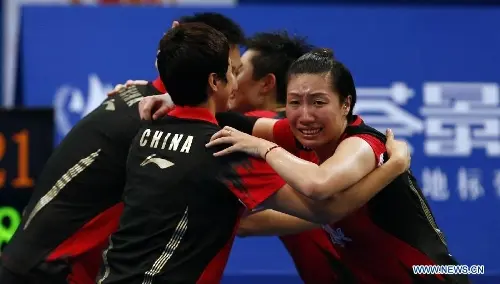
The 2013 BWF World Championships in Guangzhou, China, delivered a thrilling climax in the women's doubles event as the Chinese pair Wang Xiaoli and Yu Yang defeated South Korean opponents Jang Ye Na and Eom Hye Won to claim the gold medal. The final, held on August 11, 2013, was a showcase of high-quality badminton, with both pairs displaying exceptional technique, speed, and tactical awareness. Wang and Yu ultimately prevailed with a 2-1 scoreline, cementing their status as the dominant force in women's doubles at that time.
From the first rally, it was clear that the match would be a tightly contested battle. The Korean duo, known for their aggressive net play and defensive resilience, pushed the Chinese pair to their limits. Wang Xiaoli and Yu Yang, however, relied on their powerful smashes, excellent court coverage, and years of experience playing together to edge ahead in crucial moments. The first game saw the Chinese pair take an early lead, but the Koreans fought back to level the score at several points. A series of precise placements and dynamic rallies eventually gave Wang and Yu the first game 21-15. The second game saw a resurgence from Jang and Eom, who altered their tactics to target the gaps between the Chinese players. Their strategic shift paid off as they secured the second game 21-17, leveling the match. The decider was a tense affair, with both sides exchanging points until the Chinese pair’s superior stamina and mental fortitude shone through. They clinched the third game 21-13, sparking celebrations from the home crowd and their coaching team.
This victory was particularly significant for Wang Xiaoli and Yu Yang as it marked their second world title together, having previously won in 2011 in London. Their partnership, formed in 2008, had quickly risen to the top of the world rankings. Yu Yang, born in 1986 in Liaoning, had already established herself as a formidable player in both women's and mixed doubles. Wang Xiaoli, born in 1989 in Shandong, brought youthful energy and powerful drives to the team. Together, they formed a near-unbeatable combination, winning multiple Superseries titles and establishing a rivalry with other top pairs like the Chinese duo Tian Qing and Zhao Yunlei, as well as the Korean pair Jung Kyung-eun and Kim Ha-na.
The 2013 World Championships were held in Guangzhou, a city with a rich badminton tradition and a passionate fan base. The tournament featured top players from around the world, including Lin Dan in men's singles, who successfully defended his title. For the women's doubles, the event saw several upsets, including the early exit of the defending champions from Japan, but Wang and Yu remained steady throughout. Their path to the final included victories over Indonesian pair Greysia Polii and Nitya Krishinda Maheswari in the semifinals, and a quarterfinal win against compatriots Bao Yixin and Zhong Qianxin. Each match tested their adaptability and teamwork, showcasing why they were seeded first in the tournament.
Beyond the match itself, this win underscored the depth of Chinese badminton, particularly in women's doubles. China had dominated the discipline for many years, and the emergence of new pairs like Wang and Yu ensured continuity. Their victory in Guangzhou also served as a statement ahead of the 2014 Asian Games and the 2016 Rio Olympics, where they were expected to contend for gold. Unfortunately, their partnership ended in 2016 due to retirement and injuries, but their legacy remains as one of the most successful pairs in the sport's history.
The Korean duo of Jang Ye Na and Eom Hye Won also deserves mention for their spirited performance. Jang Ye Na, a left-handed player, brought versatility to the court, while Eom Hye Won's powerful backhand drives troubled the Chinese pair at times. Their silver medal was a highlight for South Korean badminton, which was rebuilding after the retirement of legendary players like Lee Kyung-won and Ra Kyung-min. The final was a testament to the high level of competition in women's doubles, a category that often sees dramatic shifts in momentum and tactical battles.
In the broader context, the 2013 World Championships were held in Guangzhou's Tianhe Sports Center, a venue that had hosted the 2010 Asian Games. The atmosphere was electric, with Chinese fans waving flags and cheering loudly for their home favorites. The event was broadcast to millions of viewers worldwide, further popularizing the sport. Wang and Yu's victory added to China's medal tally at the championships, which included gold in men's singles, women's singles, and mixed doubles, reinforcing the country's dominance in badminton.
Analyzing the strengths of Wang Xiaoli and Yu Yang, their playing styles complemented each other perfectly. Wang, often positioned at the back, had a powerful smash that could break through any defense. Yu, at the front, had quick reflexes and excellent net play, setting up opportunities for Wang to finish. Their communication on court was seamless, with minimal verbal cues needed. This synergy was built through thousands of hours of training together and a deep mutual understanding. Off the court, they were known for their discipline and focus, attributes that contributed to their consistency in major tournaments.
The 2013 victory also had emotional weight for Yu Yang, who had faced criticism after a controversial loss at the 2012 London Olympics, where she and Wang Xiaoli were disqualified for intentionally losing a match to manipulate the draw. That incident had stained their reputation, but they returned to the world stage with renewed determination. The world title in Guangzhou served as redemption, proving they could win on merit and under pressure. For Wang Xiaoli, it was a further step in establishing her own legacy, separate from her more experienced partner. She would later form other successful partnerships, but the 2013 title remained a career highlight.
The match statistics reveal the intensity of the encounter. Wang and Yu recorded 35 winners compared to 28 from the Koreans, and they committed fewer unforced errors. Their service reception was particularly strong, neutralizing the Korean pair's aggressive serves. The duration of the match was approximately 65 minutes, indicating the grueling nature of the rallies. In terms of speed, the shuttlecock reached speeds of over 300 km/h during smashes, showcasing the athleticism of all four players. The crowd was treated to a display of world-class badminton that balanced power, precision, and strategy.
Looking back, the 2013 BWF World Championships served as a milestone in women's doubles badminton. It highlighted the rivalry between China and South Korea, but also the rising strength of pairs from Japan and Denmark in subsequent years. For Wang Xiaoli and Yu Yang, the win was not just a title but a testament to their resilience and skill. They continued to compete at the highest level for several more seasons, winning multiple Superseries titles and the 2015 World Championship bronze. Their influence on the game extended beyond their results, inspiring a new generation of Chinese doubles players to adopt aggressive, fast-paced styles.
In conclusion, the women's doubles final at the 2013 BWF World Championships was a memorable clash that saw Wang Xiaoli and Yu Yang overcome a spirited Korean challenge to take the gold. The match embodied the essence of competitive badminton: intense rallies, tactical shifts, and emotional highs. It remains a cherished memory for fans and a highlight in the careers of these exceptional athletes. The legacy of this victory continues to be discussed in badminton circles, serving as a benchmark for excellence in the sport.
Source: Globaltimes News