

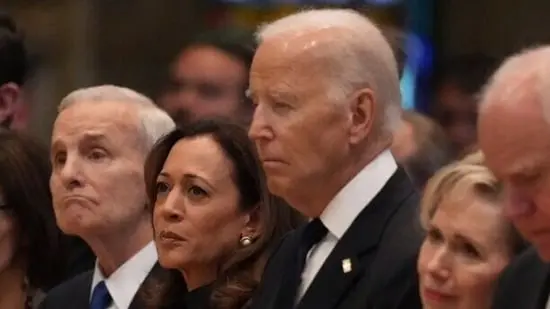
In recent weeks, a flood of revived allegations against former President Joe Biden has dominated political headlines, coinciding with a surge of speculation about Vice President Kamala Harris potentially positioning herself for a 2028 presidential bid. The accusations, which had largely faded from public discourse after Biden left office, are now being thrust back into the spotlight by conservative media outlets, disgruntled former staffers, and online activists. At the same time, a growing chorus of Democratic insiders is voicing criticism of Biden's handling of the 2024 election, particularly his decision to remain in the race until the last possible moment and then abruptly bow out, leaving Harris to shoulder the burden of a fractured campaign. This dual narrative—old, unproven claims against Biden paired with fresh grievances about his political judgment—is reshaping the early conversations around Harris's potential White House run.
Background of the Accusations
The accusations against Joe Biden are not new. They surfaced during the 2020 Democratic primary and general election campaigns, most notably the allegation from Tara Reade, a former Senate staffer who claimed that Biden sexually assaulted her in 1993. Biden denied the accusation unequivocally, and a review of Senate records by multiple news organizations found no evidence to support the claim. During the 2020 campaign, the story faded amid broader focus on policy and the pandemic. However, in recent months, the same allegations have been repackaged and amplified, often through social media channels and partisan websites, as part of a broader effort to undermine Biden's legacy. The current resurgence appears to be driven by a combination of factors: the approach of the 2028 election cycle, a desire by some Republicans to tar Harris by association, and lingering frustration among progressive activists who feel Biden failed to fully address such issues. The timing is particularly volatile because Harris, as Biden's former running mate, is inextricably linked to him. Any renewed focus on Biden's personal conduct could directly affect her viability as a candidate.
Insider Criticism of Biden's 2024 Election Management
Separately, a significant number of former Biden administration officials and campaign aides have begun to speak publicly about what they describe as serious missteps during the 2024 election. According to multiple sources who worked closely with the president, Biden was hesitant to acknowledge the depth of concerns about his age and mental acuity. Despite internal polling showing a steady erosion of support among key demographics—particularly younger voters, independents, and suburban women—Biden insisted on running for a second term. His decision to enter the race without a clear succession plan created enormous uncertainty. When he finally withdrew in August 2024, he did so in a rushed and poorly coordinated manner, leaving Harris little time to build her own campaign infrastructure or differentiate herself from the administration's record. Many insiders argue that this delay contributed directly to Harris's difficulty in gaining traction against the eventual Republican nominee. They point to a string of missed opportunities: Biden could have stepped aside earlier, allowed a robust primary, or at least ensured a longer runway for his vice president. Instead, his stubbornness and opaque decision-making alienated donors, frustrated party leaders, and handed the opposition a powerful narrative of dysfunction.
Kamala Harris's Political Standing and 2028 Prospects
Kamala Harris has spent the months since the 2024 election working to rebuild her political brand. She has kept a relatively low profile, appearing at select fundraisers and policy events, while also investing heavily in a political action committee aimed at supporting down-ballot candidates. The early buzz about 2028 is both a blessing and a curse. On one hand, it keeps her name in circulation and allows her to be seen as a frontrunner for the Democratic nomination. On the other hand, it subjects her to intense scrutiny and forces her to navigate the complicated legacy of the Biden administration. The resurfaced accusations against Biden pose a unique dilemma for Harris. She cannot fully distance herself from her former boss without appearing disloyal, yet she also cannot afford to be weighed down by damaging headlines that she had no part in. Her team has reportedly adopted a strategy of silence regarding the allegations, hoping that the media cycle will move on. Meanwhile, they are emphasizing her own record—her work on reproductive rights, voting access, and economic justice—while trying to pivot the conversation toward the future. However, the insiders' criticism of Biden's handling of the election is harder to sidestep, as it directly implicates the strategic environment that shaped her own candidacy.
Analysis of the Intersection Between Accusations and Insider Criticism
The convergence of these two stories—old accusations against Biden and new critiques of his electoral strategy—creates a complex media environment for Harris. Each narrative reinforces the other in subtle ways. The revived allegations feed a broader narrative of moral and personal inadequacy within the Biden administration, which in turn lends credence to the idea that Biden's judgment was flawed across multiple dimensions. Insiders who criticize Biden's management of the 2024 race often point to his refusal to address personal controversies head-on, suggesting that a similar pattern of deflection hurt the campaign's ability to counter attacks. For example, during the 2020 campaign, Biden's team was highly effective at deflecting questions about the Reade allegation by focusing on policy and character. But in 2024, with a younger and more skeptical electorate, the same strategy backfired. Voters wanted transparency, not deflection, and the campaign's evasiveness contributed to a perception of arrogance and weakness. Harris, as the direct beneficiary of Biden's ultimate withdrawal, now carries the burden of that perceived arrogance. She must contend with a party base that is disillusioned with the old guard and eager for new, untainted leadership.
Broader Implications for the Democratic Party
The resurfacing of these accusations and the insider criticism come at a critical time for the Democratic Party. After losing the White House in 2024, the party is in the middle of a soul-searching exercise about its identity, messaging, and leadership. The 2028 primary is still years away, but the early positioning has already begun. Several potential candidates—including governors from states like California, Michigan, and Illinois—are quietly building networks, giving speeches, and testing messages. Harris, despite her advantages as a former vice president and the first woman of color to hold that office, faces an uphill battle. She must overcome low approval ratings that were baked in during the Biden years, as well as the perception that she lacks a clear policy vision. The Biden accusations, whether true or not, provide her opponents with ready-made attack lines about judgment, loyalty, and accountability. Moreover, the insider criticism offers a roadmap for her rivals: they can argue that Harris was not just a victim of circumstance but a participant in a flawed administration that failed to learn from its mistakes. The combination of personal and political baggage may prove too heavy, especially if the party decides it needs a clean break from the Biden era.
The Role of Media and Public Perception
Media coverage plays a pivotal role in shaping how these narratives affect Harris's prospects. The vast majority of mainstream news outlets treat the Reade allegation as an unsubstantiated claim, but they also cover the political fallout as a legitimate story. The insider criticism, on the other hand, is reported as substantive news because it comes from named sources with firsthand knowledge. This asymmetry can create a distorted picture: the accusation remains in the background as a vague character stain, while the insider critique becomes a concrete, evidence-based indictment of the administration's competence. Harris's media team is keenly aware of this dynamic. They are working to steer coverage toward her policy initiatives and away from the drama of the Biden years. However, in an era of polarized media, those efforts are often overwhelmed by a small number of viral stories. Social media algorithms tend to amplify incendiary content, and the combination of an old sexual misconduct allegation with a bitter insider account of political failure is precisely the kind of mix that drives engagement. As a result, the public impression of Harris may be formed more by these viral moments than by any substantive policy rollout.
Compounding the issue is the challenge of fact-checking and contextualization. Many voters do not have the time or inclination to delve into the nuances of ancient allegations or internal campaign dynamics. They rely on headlines and short clips, which inevitably simplify complex stories. For Harris, this means that she is constantly fighting an uphill battle to define herself on her own terms. The Biden connection is a double-edged sword: it gives her a claim to experience and credibility among establishment donors, but it also ties her to controversies that she cannot control. The 2028 race, if it materializes, will be a test of whether she can successfully pivot from the shadow of her predecessor and convince the electorate that she is her own candidate with her own vision.
Ultimately, the resurfacing of vile accusations against Joe Biden and the insider criticism of his 2024 campaign management are two separate but interrelated phenomena that are already shaping the early contours of the 2028 Democratic primary. For Kamala Harris, the immediate challenge is to navigate this treacherous landscape without being defined by it. Her team is reportedly focusing on a strategy of positive, forward-looking messaging, but the gravitational pull of the past is strong. As buzz around her candidacy grows, so too will the scrutiny of her connections to Biden, both personally and politically. Whether she can rise above these challenges will depend not only on her own skills and messaging but also on the evolving priorities of the Democratic electorate and the overall political environment in the coming years. The next chapter of American politics is being written now, and the intersection of old allegations, insider grievances, and new ambitions will undoubtedly play a central role in that story.
Source: Hindustan Times News