

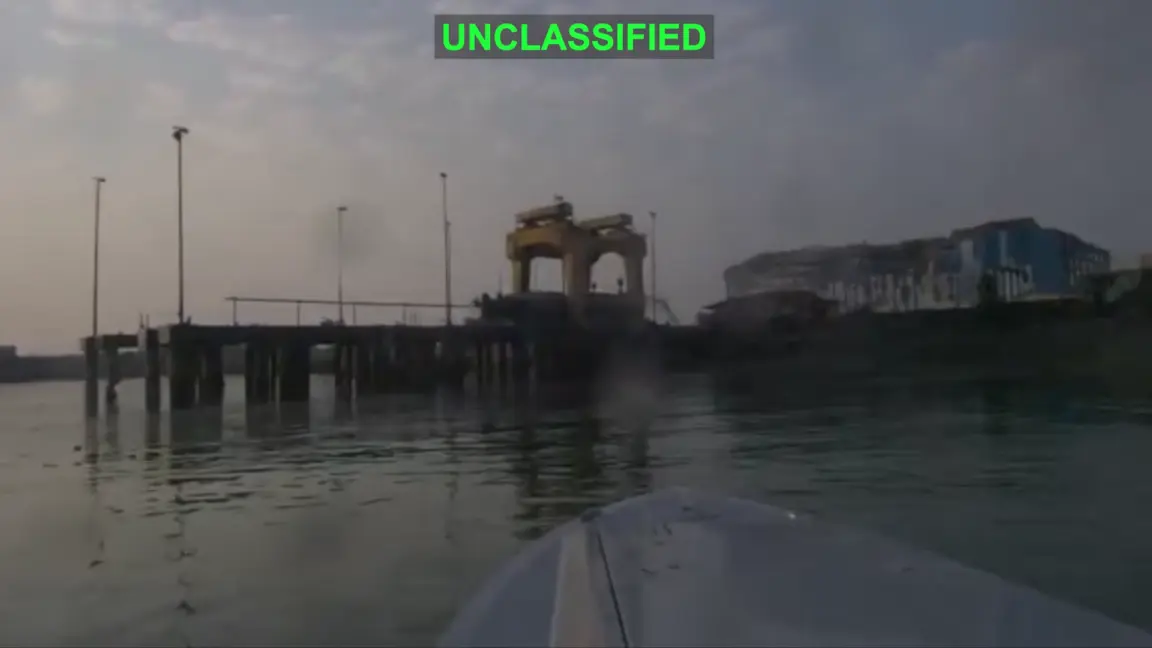
For the first time in its history, the US military sent explosive-laden drone boats into combat, attacking an Iranian midget submarine and naval port. The unprecedented use of such kamikaze sea drones by the United States comes nearly a decade after Iranian and Houthi forces first demonstrated such weapons.
The US military shared a video showing three "one-way attack surface drones" exploding after approaching an Iranian midget submarine and ship maintenance facility at Iran’s Bandar Abbas Naval Base on the night of July 12. US Central Command, the US military combat command responsible for Middle East operations, described the strikes in a social media post as the "first time American forces have employed sea drones in combat operations."
According to USNI News, a news service from the nonprofit US Naval Institute, the US drone boats were able to "make a low-speed, uncontested approach" to their targets before exploding. USNI News also identified one of the targets as an Iranian Ghadir-class midget submarine that was out of the water while suspended from a gantry.
Unpacking the Corsair drone boat
The technology behind the strikes involved Saronic Corsair autonomous surface vessels developed by Saronic Technologies, a defense company based in Austin, Texas. The company’s website describes the drone boat as being 24 feet in length and capable of carrying up to 1,000 pounds over 1,000 nautical miles at a top speed surpassing 34 knots.
Such Corsair drone boats supposedly have the capability to operate autonomously without direct human control, including long-range navigation and patrol missions along with regulating power consumption and engine use to loiter at a specific position, according to a Saronic blog post. They are designed to perform a wide variety of missions and were likely equipped with explosives for this specific strike.
The Corsair is part of a broader push by the US military to field low-cost, expendable uncrewed systems. Whereas traditional warships and manned aircraft are expensive to build, operate, and risk in combat, drone boats can be produced relatively cheaply and used in missions that might otherwise endanger service members.
Autonomous surface vessels are not entirely new to naval warfare. Militaries and non-state actors have experimented with remote-controlled boats for over a century, but recent advances in artificial intelligence, GPS navigation, satellite communications, and sensor miniaturization have made them far more practical and deadly. The Corsair’s ability to operate without direct human control is particularly valuable in contested environments where electronic warfare and jamming can interfere with remote control.
This marks the second notable US military use of drone boats during the current war, which began with the United States and Israel attacking Iran on February 28, 2026. The US military already used a Corsair sea drone to rescue two US Army helicopter pilots in the waters off the coast of Oman on June 8, after their US Army AH-64 Apache helicopter was taken down by a cheap Iranian Shahed drone.
That rescue operation highlighted another advantage of drone boats: their ability to reach downed pilots quickly without exposing a larger vessel or crew to possible ambush. The Corsair apparently acted as a recovery platform, helping to pull the pilots from the water before they could be captured or killed.
A history of drone boat violence
The United States is far from the first country to have used exploding drone boats, also colloquially described as kamikaze or suicide drone boats. The first confirmed use of such weapons occurred on January 30, 2017, when the Houthi faction based in Yemen struck the Royal Saudi Naval frigate Al Madinah using an uncrewed remote-controlled boat. A US Navy commander told Defense News that the Houthi weapon was likely developed with the technical assistance of Iran, which has long supported the Houthis.
In more recent years, the Ukrainian military has also developed and deployed drone boats for asymmetric warfare at sea since Russia launched a full-scale invasion of Ukraine in February 2022. Despite lacking a traditional navy, Ukraine has used a combination of flying drones and explosive drone boats to strike Russian warships and tankers, forcing Russia to withdraw its Black Sea Fleet to bases farther from Ukraine and cutting off vital Russian shipping routes.
Ukrainian drone boats have also achieved several milestones in military history by using missiles to shoot down Russian helicopters and acting as surface platforms to deploy small flying drones to strike Russian air defenses. Most recently, a Ukrainian drone boat even deployed an armed ground robot onto contested coastal territory in an unprecedented amphibious operation.
The evolution of drone boats in Ukraine has been rapid. What began as jet-skis and small civilian boats rigged with explosives has grown into purpose-built military vessels with advanced navigation and targeting systems. Ukrainian engineers have iterated on designs, adding satellite links, thermal cameras, and even rocket launchers to these unmanned platforms. The result has been a decisive advantage in the Black Sea, where Russia once dominated and now struggles to protect its ships and infrastructure.
The Houthi attack in 2017 was the opening chapter in a broader pattern of asymmetric naval warfare. By using a cheap, uncrewed boat packed with explosives, the Houthis demonstrated that even a non-state actor could threaten a modern frigate. Since then, the Houthis have continued to develop and launch drone boats in the Red Sea and the Bab el-Mandeb strait, targeting commercial shipping and naval vessels. Iran, too, has invested heavily in similar technologies, viewing them as a way to counter US naval superiority in the Persian Gulf and the Strait of Hormuz.
Iran’s own inventory of fast attack craft and small submarines has long been a concern for US naval planners. The Ghadir-class midget submarine struck in the latest US operation is a key part of Iran’s asymmetric fleet. These small submarines are difficult to detect and can be used to lay mines, deliver divers, or launch torpedoes in shallow waters. By targeting one while it was out of the water, the US military was able to destroy a valuable asset without a costly naval duel.
What the US deployment means
It’s unclear how the US military may continue deploying drone boats as President Donald Trump once again ramps up the war with Iran following the collapse of a supposed ceasefire. The US drone boat strikes came as part of a broader attack by conventional US military forces on Iranian targets in recent days, including strikes by US fighter aircraft and warships.
The use of these sea drones may signal a doctrinal shift in how the US Navy approaches coastal and littoral combat. Rather than using expensive destroyers or submarines to close with enemy shore defenses, commanders can now send a fleet of cheap, expendable drone boats to absorb fire and strike high-value targets. This approach mirrors the broader trend across the US military toward "disposable" systems that can be used in high-risk missions without putting personnel in danger.
Still, there are limitations. Autonomous navigation in complex maritime environments is difficult, and drone boats can be jammed, hijacked, or destroyed by defensive weapons. The current Corsair appears to rely on a combination of pre-programmed waypoints and remote supervision, which means it could be vulnerable to electronic warfare. Moreover, the ethics of using fully autonomous lethal systems remain controversial, and the US military has insisted that human operators remain in the loop for weapons release.
The US military has also been using one-way aerial attack drones for the first time during its war with Iran—LUCAS drones based in large part on Iranian-developed Shahed drones. Along with the drone boats, the United States is following the example of less powerful countries or factions that have used inexpensive drone weapons to pursue asymmetric warfare. The US military is currently trying to procure a new generation of cheaper surveillance and strike drones, especially after losing dozens of costly hunter-killer Reaper drones collectively worth more than $1 billion in the war against Iran.
The shift toward cheaper, expendable drones represents an acknowledgment that high-cost platforms are not always the best answer in modern conflicts. A $30 million Reaper drone can be shot down by a $2,000 missile, while a fleet of small drones can saturate defenses and force an adversary to spend far more to counter them. This calculus is familiar to the Houthis and the Ukrainians, both of whom have used low-cost drones to create enormous problems for better-equipped militaries.
For the United States, the deployment of explosive drone boats in combat is both a tactical achievement and a strategic signal. It shows that the US military is willing to embrace the same kind of asymmetric tactics that its adversaries have used against American forces and allies. It also raises the bar for future naval operations, where unmanned systems will likely play an even larger role in everything from surveillance to strikes to logistics.
As the war with Iran continues, the US military will likely expand its use of drone boats and other uncrewed systems. The Corsair is just one example of a rapidly growing family of autonomous naval vehicles, including larger unmanned surface vessels and underwater drones. What began as an experiment in counter-piracy and mine countermeasures has now become a central element of modern combat.
Source: Ars Technica News