

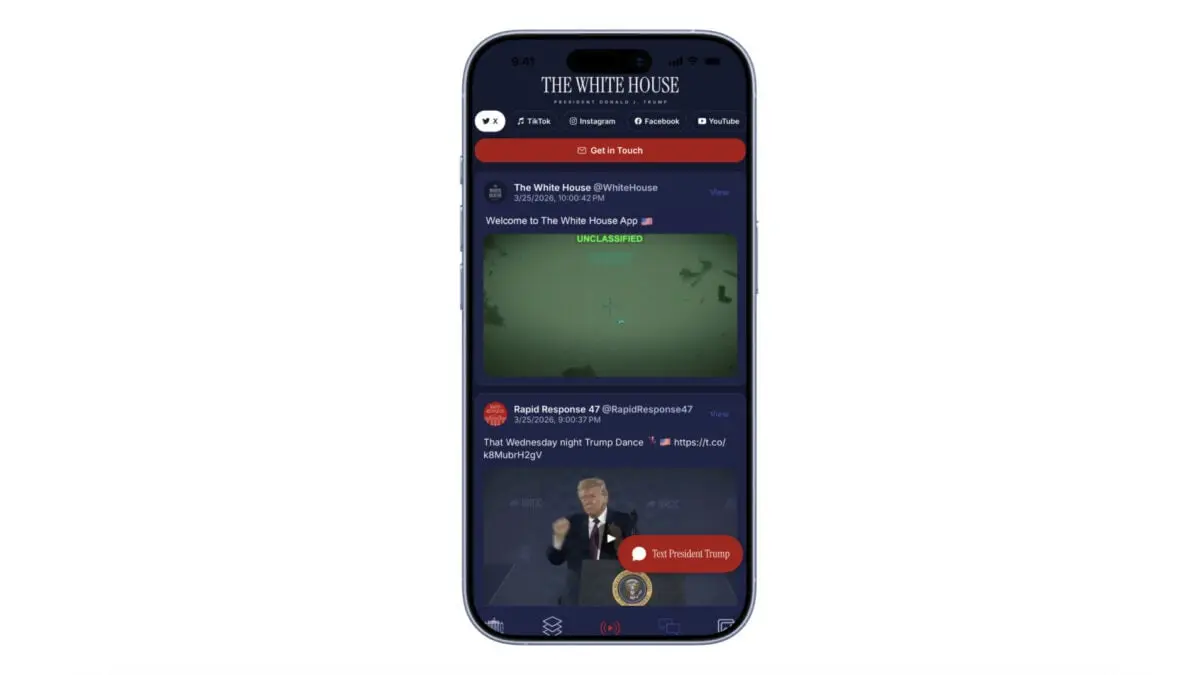
The White House has reportedly directed the Department of Homeland Security (DHS) to automatically install the official White House app on all agency-issued mobile devices. The move, first reported by Politico, mirrors a 2014 incident where U2’s album “Songs of Innocence” was auto-loaded onto iPhones, but with far more serious implications for privacy and cybersecurity.
What the App Offers
Released in March 2026, the White House app is available on both Apple’s App Store and Google Play. According to the White House, it provides “unfiltered, real-time updates straight from the source” – that source being President Donald Trump. Features include breaking news alerts, video streaming, a library of archived speeches and sound bites, and a tool to “stay connected” with new policies. Users can also send feedback via voice or text.
An email sent to DHS employees on Tuesday, seen by Politico, described the app as “a convenient way to access official White House communications, including announcements, executive actions, speeches, livestreams, videos and other updates.”
Auto-Installation Raises Red Flags
The Trump administration has instructed federal agencies to begin installing the app on government phones. The Federal Aviation Administration (FAA) is reportedly already slated to receive the app as an auto-download, according to Government Executive. But cybersecurity experts warn that forced installations could create vulnerabilities.
Sonny Hashmi, a former IT executive for the General Services Administration, told Government Executive that auto-installs are “cause for alarm.” He explained, “Any app that is installed on government issued devices can potentially create backdoor access to government networks behind the firewall.” Hashmi’s concerns echo those of many security professionals who see the app as a potential vector for data breaches or surveillance.
Data Privacy Concerns
According to Notus.org, the app shares user data – including time zone, IP address, and device identifiers – with third parties. The site notes that the app “doesn’t disclose its data sharing the way most others do,” raising questions about compliance with federal privacy standards. For DHS employees, who already handle sensitive information, this could represent an unacceptable risk.
The White House has not commented on the specific data collection practices. However, the app’s privacy policy, available on the White House website, states that information may be used for “improving user experience” and “analytics.”
Historical Context: The Obama-Era White House App
This is not the first White House app. In 2010, during Barack Obama’s presidency, an app called “The White House” was released. That app, now defunct, offered news, photos, and videos from the administration. Critics at the time noted that it was relatively basic, but it did not prompt the same privacy backlash because it did not include push alerts or extensive data sharing. The 2010 app was also not automatically installed on government devices.
The current app’s more aggressive features reflect the Trump administration’s focus on direct communication with the public and federal workers. The app’s breaking news alerts, in particular, could be used to disseminate political messaging instantly.
Implications for Federal Employees
For DHS employees, the forced installation may feel like an intrusion. While the app is intended to keep workers informed, it also blurs the line between official communications and political propaganda. Some employees may worry that opting out – if possible – could be seen as disloyalty. The email obtained by Politico did not specify whether employees can uninstall the app or disable notifications.
Nick Marinos, a former Government Accountability Office director of IT security, told the Washington Post that “any app that collects location data and sends push notifications creates risks for operational security.” DHS agents, border patrol officers, and cybersecurity staff often work in sensitive environments where phone metadata could be exploited.
Moreover, the app’s ability to stream live video and record voice feedback means it could potentially be used for passive surveillance. Although the White House denies any surveillance intent, the technical capabilities are cause for concern.
The Bigger Picture: Government Phone Management
The auto-installation of the White House app is part of a broader trend where federal agencies standardize software on issued devices. In recent years, the government has deployed mobile device management (MDM) solutions that allow IT departments to push apps and policies. However, such systems are typically used for security tools, not political communications.
Privacy advocates argue that the administration is overstepping. “This is not a necessary security update; it’s a political tool,” said Jen Caltrider, a researcher at Mozilla’s Privacy Not Included project. “Federal employees should not be forced to have a presidential propaganda app on their work phones.”
The Electronic Frontier Foundation (EFF) has also raised alarms, noting that the app’s data sharing could violate the Privacy Act of 1974, which limits how agencies collect information about individuals.
What’s Next
As of now, the app is being rolled out across DHS. Similar mandates may follow for other agencies including the Department of Defense and the Department of Energy. The White House has not set a deadline for compliance, but employees are expected to see the app appear on their phones in the coming weeks.
The controversy highlights the tension between the administration’s desire for direct communication and the need to protect federal networks and employee privacy. Without clear opt-out mechanisms or transparency about data usage, the White House app may become a flashpoint for legal challenges.
White House Press Secretary Karoline Leavitt declined to comment on the record, but a spokesperson reiterated that the app is “an official tool to keep Americans informed.”
Technical Security Analysis
Cybersecurity researcher Alec Muffett, known for his work on encrypted messaging, examined the app’s code and found that it uses standard libraries for analytics and push notifications. However, he noted that the app requests permissions to access location, camera, and microphone – permissions that are unnecessary for a news app. “If the app can access the microphone, it can potentially record audio in the background,” Muffett said in a Twitter thread. “For DHS employees, that’s a red flag.”
The app is built on a platform called “Whitehouse.gov Mobile,” which appears to be a custom wrapper around the official website. This architecture means that all content is served from White House servers, giving the administration full control over what appears on employees’ screens. If the app were compromised, an attacker could push malicious content or redirect users to phishing sites.
Additionally, the app uses third-party analytics services such as Google Analytics and Facebook SDK, which are common in commercial apps but unusual for government-issued software on sensitive devices. The presence of these SDKs means that data could be transmitted to servers outside the government’s control, potentially violating federal data storage requirements.
Legal and Policy Challenges
The forced installation may also contravene the Paperwork Reduction Act, which governs how agencies collect information from the public. While the app is ostensibly for communication, its data collection could be seen as a form of automated information collection without proper clearance. The American Civil Liberties Union (ACLU) has indicated that it is reviewing the app for potential lawsuits.
Furthermore, the Biden administration (predecessor) had strict rules about political activities on government devices. The Hatch Act prohibits federal employees from engaging in partisan political activity while on duty. If the app sends political messages or promotes the president’s agenda, it could put employees in a difficult position.
Representative Jamie Raskin (D-MD), ranking member of the House Oversight Committee, sent a letter to DHS asking for more information about the app’s deployment. “The forced installation of a political app on federal devices raises serious concerns about the misuse of government resources and the erosion of nonpartisan civil service,” Raskin wrote.
Comparison with Other Government Apps
The White House app is not the only government app to collect data. The Department of Veterans Affairs has a mobile app for health records, and the IRS has an app for tax refunds. However, those apps are voluntary and focused on specific services. The White House app is unique in its political nature and its mandated installation.
In the private sector, companies often require employees to install productivity or security apps on their work phones. But those apps typically have clear privacy policies and are managed by the company’s IT department. The White House app, by contrast, is managed by the Executive Office of the President, which operates independently from DHS IT.
The situation echoes reports from earlier this year that the Trump administration was considering a “Trump Phone” – a specialized device preloaded with White House apps and custom software. That project, reportedly led by allies of the president, has not been officially announced but would take the concept of mandated apps even further.
Employee Reactions
Reactions among DHS employees are mixed. Many are accustomed to receiving official communications through email or secure portals. The app, they say, adds an unnecessary layer of complexity. One DHS analyst, speaking on condition of anonymity, told reporters: “I don’t want another app draining my battery and collecting my data. I also don’t want to be seen as disloyal if I don’t use it.”
The National Federation of Federal Employees, a union representing DHS workers, has filed a grievance citing concerns over privacy and workload. “Our members should not be forced to install political software on their devices,” said union president Randy Erwin. “We are exploring all legal options to stop this rollout.”
The White House has not responded to these criticisms directly but has emphasized that the app is optional for the general public. The mandatory nature applies only to government employees who receive DHS-issued phones. The administration may argue that as a matter of official communications, the app is no different from installing email or calendar software.
The Role of the White House Digital Office
The app was developed by the White House Office of Digital Strategy, which has been expanding its reach under the current administration. Since taking office, President Trump has prioritized direct digital communication, using platforms like Truth Social and now his own app. The White House app represents a consolidation of these efforts into a single channel.
The digital office has also been involved in creating a new WhiteHouse.gov experience, with more interactive elements and real-time updates. The app is essentially a companion to the website, optimized for mobile push notifications. However, the decision to force installation on federal devices suggests that the administration views the app as more than a convenience – it is a tool for ensuring that its message reaches every employee.
Given the controversy, the White House may need to issue clarifications about data collection, opt-out procedures, and security measures. Until then, DHS employees and privacy advocates will remain watchful.
Source: Gizmodo News