

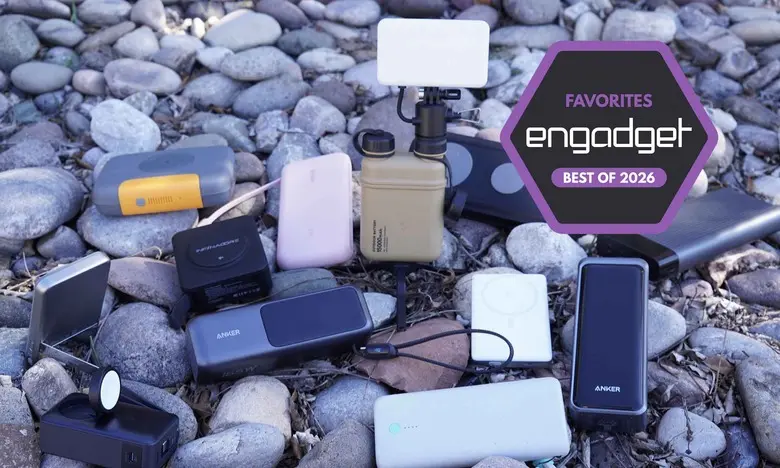
Few things are as stressful as watching your phone drop to 5 percent with no outlet in sight. A portable power bank eliminates that anxiety, but choosing one is tricky with so many models available. Over the past few years, we've tested dozens of batteries in real-world conditions, using them to charge iPhones, Android phones, tablets and laptops. Below are the best power banks for 2026, organized by use case. We also explain what to look for and how we test.
Best power banks for 2026
Best MagSafe power bank: Anker MagGo Power Bank (10K)
Capacity: 10,000 mAh | Max output: 15W wireless | Ports: One USB-C in/out | Weight: 8.82 oz
The Anker MagGo Power Bank is one of the first Qi2-certified products on the market. Qi2 brings faster 15W wireless charging and magnetic alignment. In testing, it took an iPhone 15 from near-dead to half-full in about 45 minutes. It also has a sturdy kickstand and a useful LED display showing remaining battery percentage. The USB-C port lets you charge non-wireless devices too. It costs more than ordinary MagSafe packs, but speed and build quality justify the premium.
- Pros: Fast Qi2 wireless charging, sturdy kickstand, LED display
- Cons: More expensive than basic MagSafe batteries
Best portable charger for Android: Anker Nano Battery (Foldable USB-C)
Capacity: 5,000 mAh | Max output: 22.5W | Ports: One USB-C and one built-in USB-C connector | Weight: 3.5 oz
The Anker Nano Battery is about the size of a lipstick case, yet it delivered a 0 to 65 percent charge for a Galaxy S23 Ultra in about an hour. A foldable USB-C connector means you don't need to carry a separate cable. There's also a USB-C port for refilling the battery itself or charging other devices. It's a great companion for earbuds or a quick phone top-up. If you want more capacity, Anker's 30W Nano Power Bank has 10,000 mAh and a display.
- Pros: Extremely portable, affordable
- Cons: Small enough to misplace
Best low-capacity power bank: Anker 10K Fusion
Capacity: 10,000 mAh | Max output: 30W | Ports: One USB-C in/out, one built-in USB-C cable, wall prongs | Weight: 8.8 oz
The Anker 10K Fusion solves a common problem: forgetting a cable or wall adapter. It has a built-in USB-C cable and foldable wall prongs. Despite these attachments, it's compact and delivered a full Galaxy S23 Ultra charge in just over an hour. An iPhone 15 reached 45 percent in 20 minutes. The display shows remaining charge accurately, and the corduroy-like texture adds grip. It costs less than many comparable models.
- Pros: Built-in cable and wall prongs, accurate display, affordable
- Cons: iPhone charging slower than some rivals
Best medium-capacity power bank: Belkin BoostCharge 20K with Integrated Cable
Capacity: 20,000 mAh | Max output: 30W | Ports: One built-in USB-C cable, one USB-A, one USB-C | Weight: 14 oz
Belkin's BoostCharge 20K has an integrated, magnetized USB-C cable, so you'll always have a connection method. It charged a Galaxy S24 Ultra from empty to full in 1 hour 15 minutes and an iPhone 15 to 87 percent in just over an hour. The 20,000 mAh capacity provides roughly three full phone charges. A USB-A port and USB-C port let you charge multiple devices at once. It comes in black, blue, pink or white.
- Pros: Built-in cable, four color options, great capacity for the price
- Cons: Not the fastest charging speed
Best medium-high capacity power bank: Nimble Champ Pro
Capacity: 20,000 mAh | Max output: 65W | Ports: Two USB-C in/out | Weight: 12.9 oz
The Nimble Champ Pro delivered one of the fastest charges we've seen, filling a Galaxy S23 Ultra in under an hour. It can charge an iPhone and an Android phone nearly three times over, and it can refill an iPad more than once. The battery itself recharges from the wall quickly, too. Nimble is a certified B-Corp, and the Champ Pro is made from 90 percent post-consumer plastic. A lanyard and marbled finish add personality.
- Pros: Ultra-fast charging, recycled materials, compact design
- Cons: Indicator lights can underestimate remaining charge
Best multi-device power bank: BioLite Charge 100 Max
Capacity: 25,000 mAh | Max output: 120W | Ports: Wireless pad (15W), two USB-C (100W), one USB-A, one USB-C | Weight: 1.28 lbs
The BioLite Charge 100 Max is a compact multi-device powerhouse. It can charge a phone wirelessly while also powering two USB-C devices and one USB-A device. In our tests it delivered five iPhone charges or four Galaxy charges, and it gave a MacBook Pro a 75 percent refill. The rounded, rubberized build with yellow accents looks great and is comfortable to hold. BioLite is a climate neutral-certified B-Corp that supports energy access programs.
- Pros: Compact design, fast charging, supports laptops, great company mission
- Cons: More expensive than similar-capacity rivals
Best laptop power bank: Anker Laptop Power Bank with Built-in Cable
Capacity: 25,000 mAh | Max output: 165W | Ports: Two built-in USB-C cables, one USB-A, one USB-C | Weight: 1.31 lbs
This Anker battery includes a retractable USB-C cable and a second USB-C cable that doubles as a carrying handle. The display shows remaining charge, output wattage, and estimated refill time. It charged a MacBook Pro from near-dead to 75 percent in 53 minutes. With two built-in cables, you'll never be stuck without a way to connect. The matte silver exterior feels durable, though the screen can pick up smudges.
- Pros: Two built-in cables, fast charging, detailed display
- Cons: Screen shows fingerprints easily
Best premium power bank: Anker Prime Power Bank 26K 300W
Capacity: 26,250 mAh | Max output: 300W combined | Ports: Two USB-C (140W), one USB-A (22.5W) | Weight: 1.32 lbs
Anker's Prime Power Bank is the most powerful portable charger we've tested. It can deliver 140W through each USB-C port, letting you charge two high-power laptops simultaneously. It brought an iPhone 15 to 60 percent in 30 minutes and gave a MacBook Pro more juice than any other battery in our tests. The display shows remaining charge, per-port wattage, and battery temperature. An optional charging base ($110) makes refilling effortless, but it's pricey.
- Pros: Extremely fast charging, sleek design, temperature monitoring
- Cons: Expensive, especially with the optional base
Best power bank for outdoors: Nestout 15000mAh Outdoor Battery Power Bank
Capacity: 15,000 mAh | Max output: 32W | Ports: One USB-C in/out, one USB-C in, one USB-A | Weight: 12.8 oz
The Nestout Outdoor Battery has an IP67 rating, meaning it can survive immersion in water up to a meter for 30 minutes. We dunked it in a bucket for five minutes and it worked perfectly. Screw-on caps with silicone gaskets keep out moisture, and the unit survived repeated drops from chest height. Charging speeds are slower than some rivals, and the included cable is short, but the rugged design and optional solar panel setup make it ideal for camping.
- Pros: Waterproof, durable, compatible with solar panel
- Cons: Slower charging, short cable
What to look for in a portable battery pack
Battery type
Most power banks use lithium-ion cells. They offer excellent size-to-capacity ratios, and modern versions have much higher energy density than older batteries. They also do not suffer from the memory effect that affected older rechargeable chemistries.
Flying with portable batteries
Lithium-ion batteries must be carried in your carry-on luggage, not checked bags, under TSA rules. All of our recommendations are rated at 100Wh or less, so they're allowed on flights. Some airlines now also require power banks to be kept in view while actively charging a device.
Capacity
Capacity is measured in milliamp hours (mAh). A small 5,000mAh battery can give a phone around 50 to 75 percent charge. A 20,000mAh or larger unit can charge laptops and provide multiple phone charges. In our tests, efficiency averaged around 60 percent, so a 10,000mAh battery delivers roughly 5,800mAh to a device.
Wireless
Wireless charging is convenient but less efficient than wired connections. Qi2-certified power banks support 15W magnetic wireless charging. The latest Qi2 25W standard is beginning to appear in new phones and batteries, offering even faster wireless speeds.
Ports
USB-C ports provide the fastest charging, while USB-A ports remain useful for older cables. Check each port's wattage rating, and make sure your cable supports the maximum output. Many of the best power banks now include a built-in USB-C cable, so you never forget one.
Design
Power banks are no longer just black bricks. You can find them in various colors, shapes, and finishes. Some include MagSafe compatibility, wall plugs, or kickstands. A digital display showing remaining battery percentage is a handy feature on newer models.
How we test power banks
We start by researching popular models from well-known brands and reading customer reviews. Then we purchase the most promising candidates and test them in our home office. We discharge a variety of devices down to 5 percent or lower, then charge them with each power bank. We measure charging time, total charge delivered, and how quickly the bank itself recharges. We also evaluate portability, build quality, and extra features like wireless charging and display accuracy.
Other power banks we tested
Belkin Stage PowerGrip
This 9,300mAh bank doubles as a Bluetooth camera shutter with a tripod mount. It's a niche choice for mobile photographers, but charging is slow.
Anker MagGo for Apple Watch
A 10K battery with a built-in USB-C cable and a pop-up Apple Watch charger. It's highly useful for Apple Watch owners, though too niche for a top pick.
HyperJuice 245W
A powerful 27,000mAh bank with four USB-C ports. It's fast and attractive, but it lacks USB-A and costs the same as better-equipped rivals.
EcoFlow Rapid magnetic power bank
A 5,000mAh Qi2 magnetic charger with a fold-out stand. It looks nice but didn't match the speed or capacity of our top MagSafe pick.
Mophie Snap+ Powerstation Mini
This 5,000mAh unit feels premium and has a sturdy stand, but it only provides a partial charge for most current phones.
Power bank FAQs
What's the difference between a portable power bank and a portable charger?
They mean the same thing. Portable batteries, external battery packs, and USB chargers are all terms used to describe a lithium-ion battery that can recharge your devices. Power stations are different: they are much larger, cannot be taken on planes, and can provide AC outlets.
Does fast charging ruin your battery?
Fast charging generates more heat, which is the main factor that can degrade battery health over time. Modern smartphones use heat shields, heat sinks, and software to manage temperatures, making the impact relatively small. Avoiding excessive heat exposure is the best way to protect your battery.
Can you use a power bank for all your devices?
It depends on the bank's capacity and your device's port. A 20,000mAh bank can partially charge a laptop, while a 5,000mAh bank may only top up a smartphone. As long as your device charges over USB, you can use a power bank. For devices with AC plugs or proprietary ports, you'll need a power station or a special adapter.
Source: Engadget News