

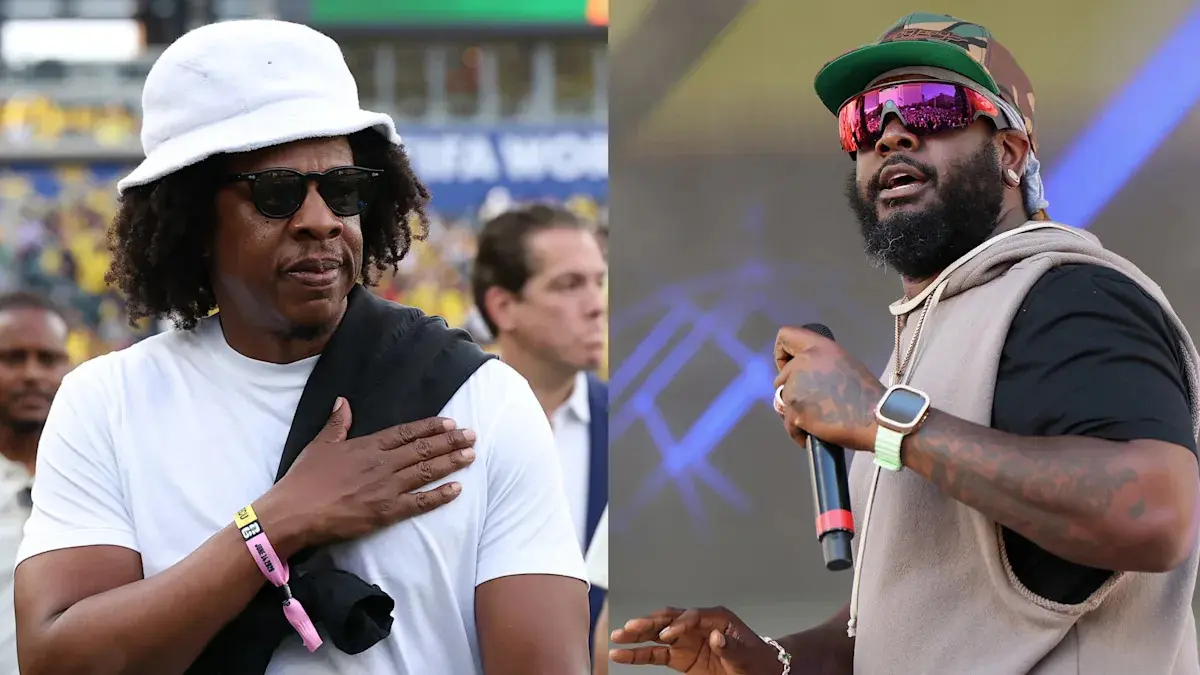
T-Pain has never shied away from discussing the complex relationship between his signature Auto-Tune style and the criticism it has received over the years. In a recent episode of the podcast ExpediTIously with Tip "T.I." Harris, the Grammy-winning singer opened up about one of the most pivotal moments in that narrative: Jay-Z's 2009 track "D.O.A. (Death of Auto-Tune)." The song, which appeared on Jay-Z's album The Blueprint 3, was widely interpreted as a broadside against the overuse of vocal pitch correction in hip-hop and R&B. For T-Pain, however, the lyrics felt deeply personal.
"I'm a Jay-Z fan still to this day," T-Pain explained during the conversation, which was released on Tuesday, June 23. "One of my favorite songs from him was 'Can't Knock the Hustle.' And getting my hustle knocked wasn't on my bingo card." The singer joked that the criticism "sucked," but his tone quickly turned serious when he admitted that hearing the song was "devastating." The emotional weight of that moment, he said, took years to process. But through maturity and reflection, T-Pain came to understand that Jay-Z's message was not a direct attack on him as an artist, but rather a broader commentary on the state of the music industry at the time.
The Context of 'Death of Auto-Tune'
When Jay-Z released "D.O.A." in mid-2009, the hip-hop world was already buzzing with conversations about the dominance of Auto-Tune. The pitch-correction software, popularized by artists like T-Pain, Kanye West, and Lil Wayne, had become a defining sound of late-2000s pop music. T-Pain, in particular, was synonymous with the effect, having used it on massive hits such as "Buy U a Drank (Shawty Snappin')" and "Bartender." His 2007 single "Buy U a Drank" spent multiple weeks at number one on the Billboard Hot 100, and his collaborations with artists like Flo Rida and Lil Wayne further cemented the Auto-Tune sound as a commercial juggernaut.
But not everyone in the hip-hop community was thrilled with the trend. Traditionalists argued that the technology masked a lack of vocal talent and that it was diluting the essence of rap music. Jay-Z, a veteran lyricist and businessman, used "D.O.A." to voice that frustration. The song's hook — "This is death of Auto-Tune, a moment of silence" — was both a declaration and a provocation. The track also included pointed lines like "You nas singin' too much/Get back to rap, you T-Painin' too much," which directly referenced the singer by name. It was this line that hit T-Pain the hardest.
An Artist's Reaction and a Public Reconciliation
In the podcast, T-Pain recalled that while he initially felt singled out, he later recognized that Jay-Z's critique was part of a larger conversation. "It just came down to me not understanding how to process somebody else's feelings and looking at things from the other side and trying to see all sides of a situation before I was able to react," he said. That shift in perspective came with time and maturity. He noted that Jay-Z's message was essentially, "Hey, guys, I'm still over here. I'm still Jay-Z. Y'all don't get too caught up with that st over there. Ain't going to last too long."
The complexity of their relationship was highlighted by a memorable live moment later that same year. During Hot 97's Summer Jam in 2009, T-Pain unexpectedly joined Jay-Z onstage while the latter performed "D.O.A." The crowd reacted with a mix of surprise and energy, and the moment became a symbol of the potential for unity despite industry tensions. In subsequent interviews, Jay-Z clarified that the song was never intended to target T-Pain specifically. In a 2009 interview with Hot 97, the rapper said, "The guys who did it, did it great. T-Pain, he does great melodies. If you listen to Kanye, great melodies. If you listen to 'Say You Will' or 'Heartless,' great melodies. Lil Wayne's 'Lollipop' was a fantastic melody. Everybody can't do it. Let them guys do it."
The Broader Impact on T-Pain's Career and Legacy
Despite the eventual understanding, the release of "D.O.A." had a tangible effect on T-Pain's career trajectory. At the time, he was at the height of his popularity, but the backlash against Auto-Tune—both from critics and fellow artists—coincided with a shift in musical trends. By the early 2010s, the sound that T-Pain had pioneered began to wane in popularity, replaced by a more stripped-down, trap-influenced production style. T-Pain himself has discussed how the constant criticism took a toll on his mental health. In previous interviews, he admitted that the negativity led him to step back from the spotlight, essentially hitting a creative low point.
But the story does not end there. T-Pain's resilience became a defining chapter of his career. He continued to release music, experimenting with new sounds and eventually earning a new wave of respect from younger artists who grew up on his work. His victory on The Masked Singer in 2020—where he performed without Auto-Tune, showcasing his natural voice—was a powerful moment of redemption. The win demonstrated that his vocal ability was never reliant on the technology; it was simply an artistic choice. That performance changed the public's perception of T-Pain, revealing a vulnerability and raw talent that had been masked by the vocoder-heavy productions of his early hits.
Auto-Tune's Enduring Legacy in Hip-Hop
Today, Auto-Tune is no longer a controversial tool; it is an accepted, even essential, component of modern pop and hip-hop production. Artists like Travis Scott, Post Malone, and Future have built entire careers around melodic, pitch-corrected vocals. In that sense, Jay-Z's "Death of Auto-Tune" did not truly kill the trend—it merely marked a moment of cultural pushback. The technology's persistence is a testament to its utility and to the artists who first popularized it. T-Pain, in particular, is now recognized as a pioneer whose influence can be heard in countless contemporary hits.
Looking back, T-Pain acknowledges that his initial reaction was fueled by ego and misunderstanding. "It was devastating, but it also taught me a lot about perspective," he said. "I had to grow up and realize that everyone is entitled to their own opinion. And as an artist, you have to be able to take criticism and adapt without losing yourself." That lesson has served him well. He continues to tour, produce, and collaborate with artists across genres, proving that his talent transcends any single technology or moment in time.
The conversation also touched on other related topics, including the state of the music industry and the role of social media in shaping artist reputations. T-Pain reflected on how the internet has magnified both praise and criticism, making it harder for artists to process feedback in a healthy way. "When Jay-Z made that song, it was just a record. Now, everything is immediate and viral," he noted. "It's a different world."
For fans and observers, T-Pain's candidness offers a rare glimpse into the human side of music feuds. While the public often sees these moments as entertainment, they carry real emotional weight for the artists involved. T-Pain's journey from feeling devastated to finding peace with Jay-Z's words is a testament to his growth as an individual and as a creative force. And while "D.O.A." may have temporarily shaken his confidence, it ultimately did not define him. Instead, it became a chapter in a larger story—one of resilience, reinvention, and respect for the ever-changing landscape of popular music.
As the podcast episode drew to a close, T-Pain reiterated his admiration for Jay-Z and his willingness to move forward without bitterness. "I'm still a fan. I always will be," he said. "And I think that, in the end, we both made great music. That's what matters."
In the decade and a half since the release of "D.O.A.," the music industry has undergone countless transformations. Yet T-Pain's story remains a relevant case study in how artists navigate criticism, adapt to change, and ultimately leave an indelible mark on culture. His honesty about the pain Jay-Z's words caused—and his journey toward understanding—resonates with anyone who has ever felt personally attacked in a public forum. It is a reminder that even the most successful artists are human, and that growth often comes from the most challenging experiences.
Source: Yahoo Entertainment News