

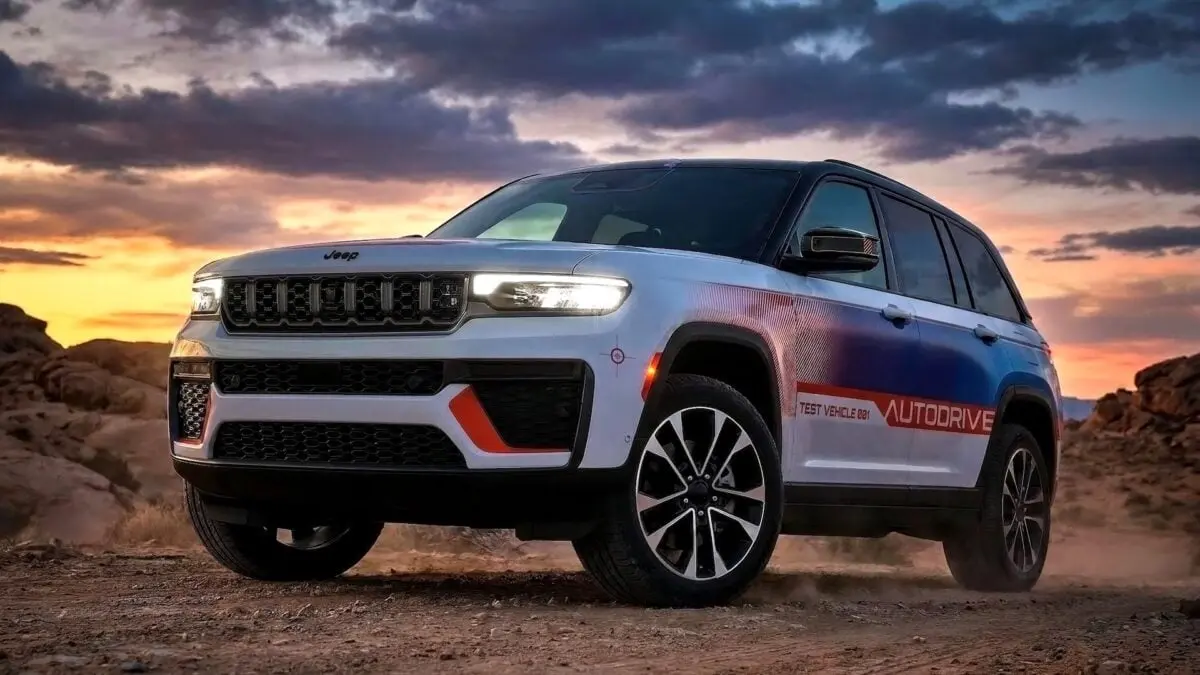
As robotaxi services steadily pop up in cities around the world, self-driving technology in commercial passenger cars has been slower to catch up. Stellantis, the parent company of Jeep, Ram, Dodge, Fiat, and several other automotive brands, is the latest automaker to announce plans to bring more advanced automated driving capabilities to its vehicles.
The company announced a new strategic technology partnership with UK-based startup Wayve. The partnership aims to integrate Wayve's AI Driver system into Stellantis' STLA AutoDrive platform. This could eventually equip some Stellantis vehicles with hands-free, supervised driving technology that works on both city streets and highways, similar to systems already available on Tesla and Rivian vehicles. Stellantis and Wayve are describing this first iteration as a Level 2++ system, meaning drivers would still need to pay attention to the road and supervise the vehicle as it drives.
The first vehicle integration is planned for North America in 2028. Stellantis says the platform can support more advanced automated driving features down the road as regulations and customer expectations evolve. “This agreement marks an important next step for Wayve and Stellantis in scaling our technology together,” said Alex Kendall, co-founder and CEO of Wayve, in a press release. “Our teams have already demonstrated how quickly the Wayve AI Driver can be integrated across Stellantis’ vehicle platforms, bringing up a prototype in less than 2 months.”
While there is no word yet on which specific brands or models would get the technology first, Wayve developed a prototype with Stellantis in just a few weeks on the company’s Jeep Cherokee platform. Jeep Cherokee is a popular SUV model that fits well with the rugged, family-oriented image of Jeep. The choice of Cherokee as the prototype platform suggests that Stellantis may prioritize its SUV and off-road oriented brands for early deployment of the new system, but the technology is designed to be vehicle-agnostic.
What is Level 2++ Autonomy?
Level 2++ is an industry term that sits between Level 2 (partial driving automation with hands-on) and Level 3 (conditional automation where the system can take over control but the driver must be ready to intervene). In a Level 2++ system, the vehicle can handle steering, acceleration, and braking simultaneously, and it can also perform advanced maneuvers like lane changes and navigating complex intersections, all while the driver monitors the road. However, the driver remains fully responsible at all times. Tesla's Full Self-Driving (FSD) and Rivian's Highway Assist are examples of Level 2++ systems currently available.
The term “plus-plus” indicates that the system goes beyond typical Level 2 by incorporating features like automated lane changes, traffic light and stop sign recognition, and sometimes even navigation on city streets. For Stellantis, achieving Level 2++ on both highways and urban roads would put it in direct competition with Tesla, which has been refining its FSD system for years, and with other automakers like General Motors (Super Cruise) and Ford (BlueCruise), which currently operate primarily on mapped highways.
Wayve’s AI Driver is built on a different philosophy than many competitors. Instead of relying on highly detailed pre-mapped roads (like GM’s Super Cruise) or a combination of maps and sensor fusion (like Waymo), Wayve uses a camera-based system that learns from real-world traffic through machine learning. This approach theoretically eliminates the need for costly and time-consuming map updates. The AI Driver is trained on vast amounts of driving data, allowing it to generalize to new environments without explicit maps. This makes it potentially easier and faster to deploy across different vehicle platforms and geographic regions.
Wayve’s Rising Profile in the Autonomous Driving Space
Founded in 2017, Wayve has rapidly emerged as one of the most well-funded autonomous driving startups in Europe. The London-based company focuses exclusively on software, providing an “AI Driver” that can be adapted to work on everything from passenger cars to delivery vans. The company’s vehicle-agnostic approach has attracted significant investment from some of the biggest names in technology and automotive.
Earlier this year, Wayve announced that it had closed a $1.2 billion Series D investment round with a range of investors, including SoftBank, Microsoft, Nvidia, and Uber. And just last month, Advanced Micro Devices (AMD), Arm, and Qualcomm Ventures announced a separate $60 million investment in the company. This influx of capital underscores the industry’s confidence in Wayve’s technology and its ability to scale.
Uber’s investment is particularly strategic: it will support Wayve-powered robotaxis on the Uber platform. The companies intend to launch their first service in London in 2026, with plans to expand across multiple markets. This robotaxi application is separate from Stellantis’ passenger car integration, but it demonstrates Wayve’s versatility and its ambition to become a leading provider of autonomous driving software for multiple use cases.
Nissan has also signed on to use Wayve’s technology. In December 2025, the Japanese automaker announced that it would integrate Wayve’s tech into a broad range of its cars starting in 2027. Nissan’s adoption reinforces the idea that Wayve’s software-agnostic approach is appealing to traditional automakers that want to add advanced driver-assistance features without building proprietary systems from scratch.
Stellantis’ Broader ADAS Strategy
Stellantis has been relatively cautious in the autonomous driving race compared to some rivals. While the company has offered adaptive cruise control, lane-keeping assistance, and other Level 2 features on many of its models, it has not yet launched a hands-free system like Ford’s BlueCruise or GM’s Super Cruise. The partnership with Wayve signals that Stellantis is now ready to leapfrog directly to Level 2++ capabilities, skipping intermediate steps.
The STLA AutoDrive platform is part of Stellantis’ larger STLA technology architecture, which includes dedicated electric vehicle platforms (STLA Medium, Large, Frame, and Small). The AutoDrive platform is designed to be scalable and modular, allowing Stellantis to deploy different levels of automation across its brands. By partnering with Wayve, Stellantis gains access to advanced AI software without having to invest heavily in its own autonomous driving research from the ground up.
Given the diversity of Stellantis’ brand portfolio—from Jeep’s rugged SUVs to Ram’s heavy-duty trucks to Dodge’s performance-oriented muscle cars—the Wayve AI Driver will need to be highly adaptable. Off-road driving scenarios, for example, present unique challenges that are not typically encountered in urban robotaxi operations. While the initial integration is focused on highway and city streets, Stellantis may eventually explore how the system can handle more complex environments.
Competitive Landscape and Challenges
The market for Level 2++ systems is becoming increasingly crowded. Tesla leads in terms of real-world deployment, with over a million vehicles equipped with its FSD hardware. However, Tesla’s approach has been controversial, with regulatory scrutiny and safety incidents. Rivian has also gained attention with its Highway Assist and upcoming City Assist features, which are praised for their smooth performance.
General Motors’ Super Cruise, now available on many Cadillac, GMC, and Chevrolet models, is one of the most mature hands-free systems, but it is limited to divided highways with high-definition mapping. Ford’s BlueCruise operates similarly. Both systems are considered Level 2 hands-free, but they lack the urban capability that Stellantis and Wayve are targeting.
Wayve’s camera-centric approach has advantages and disadvantages. Cameras are cheaper than lidar and radar, and they provide rich visual data that can be processed by deep learning models. However, cameras struggle in adverse weather conditions like heavy rain, snow, or fog, and they can be blinded by direct sunlight. Wayve’s reliance on machine learning also means that the system’s performance is dependent on the quality and diversity of its training data. If the training data does not adequately cover certain scenarios (e.g., unusual road layouts, traffic signs, or cultural driving behaviors), the system may behave unpredictably.
Another challenge is regulation. While Level 2++ systems are generally legal because the driver remains responsible, regulators in different countries have varying requirements for approval. Stellantis and Wayve will need to certify their system in North America first, but expansion to other markets may require additional testing and modifications.
Timeline and Vehicle Integration
The first vehicle integration is planned for North America in 2028, which gives Stellantis and Wayve about two years to develop, test, and certify the system on a production vehicle. The rapid prototype development on Jeep Cherokee suggests that the software can be adapted relatively quickly, but production-level validation will require extensive testing across different road conditions, weather scenarios, and use cases.
It remains unclear which specific Stellantis brands or models will get the technology first. Given the prototype work on Jeep Cherokee, it is plausible that Jeep will be one of the early beneficiaries. Jeep is a high-volume brand for Stellantis, and adding hands-free driving could enhance its appeal to families and adventure seekers. Ram trucks and Dodge muscle cars could also benefit: Ram could offer the system for long-haul highway driving, while Dodge might integrate it into its performance vehicles to assist with daily commuting.
Stellantis has also hinted that the STLA AutoDrive platform can support Level 3 and even Level 4 autonomy in the future, as regulations and consumer acceptance evolve. Level 3 would allow drivers to take their eyes off the road in certain conditions, while Level 4 would allow the car to drive itself without human oversight in geofenced areas. Wayve’s long-term goal is to achieve full self-driving, but the partnership with Stellantis is focused on the near-term Level 2++ rollout.
The news of this partnership has been well received by industry analysts, who see it as a smart move for Stellantis. By partnering with an established startup rather than building its own system, Stellantis can bring advanced technology to market faster and with lower risk. Meanwhile, Wayve gains a major automotive partner that can deploy its software on millions of vehicles, providing valuable real-world data to improve the AI Driver.
As the automotive industry continues to evolve toward greater automation, collaborations like this one between Stellantis and Wayve will become increasingly common. Traditional automakers recognize that they cannot go it alone in the complex world of autonomous driving; they need the agility and expertise of specialized technology companies. For consumers, this means that hands-free driving features may soon become standard on a wider range of vehicles, not just high-end luxury models or EVs from Silicon Valley.
Source: Gizmodo News