

Stop Your Phone from Charging All the Way
A Full Battery Wears Out a Lot Faster
Before you do anything else with your phone, it's worth setting up one thing that'll protect the battery for the long haul. Regardless of what you may think, every lithium-ion battery is basically a consumable. That means it's going to wear down over time, no matter what you do. The time it takes to become useless depends a lot on the environment it lives in and how you charge it day to day. Your phone might be a powerhouse, but its battery is still subject to the same chemistry as any other lithium-ion cell, and pushing it too hard for too long will erode its capacity and performance.
That's why it makes sense to set this up on day one, before your charging habits even have a chance to start doing damage. However, it's never too late to start, and I didn't start doing this until years after I bought my phone. Taking control of how your phone charges right from the start means you're heading off a lot of that wear before it ever happens, and your battery will simply last longer as a result.
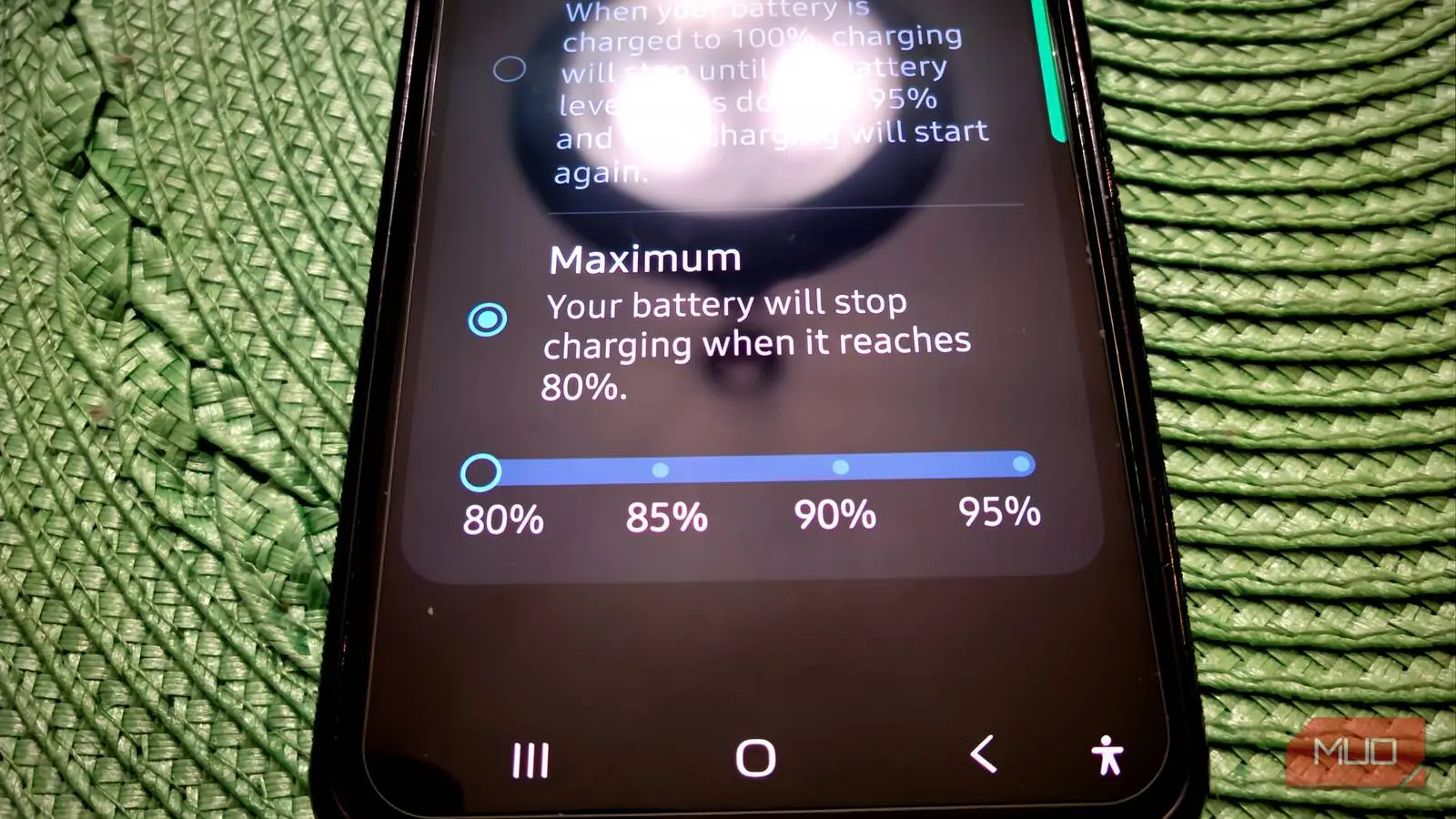
What you want to do is go to your battery health settings and enable the option that stops charging at 80 percent. The idea is to keep the battery out of that high-voltage zone it hits when you push it all the way to full. Normally, charging to 100 percent means the battery's sitting at somewhere between 4.20 and 4.35 volts per cell, which is great for squeezing out every bit of runtime, but rough on the battery itself.
That last stretch, from 80 to 100 percent, is the hardest part of the whole charge. You're basically cramming lithium ions into a space that's already nearly full, and that generates extra heat the battery doesn't need. Sitting at that high voltage for any length of time speeds up the unwanted chemical reactions going on inside that are actively killing the battery. If you cap it at 80 percent instead, you're sidestepping most of that voltage-driven stress. Do that consistently, and you could double, maybe even quadruple, how many charge cycles your battery has in it.
If you've got an iPhone 15 or newer running iOS 18, just open Settings, go to Battery, tap Charging, and pick the 80 percent charge limit option. On Android, go to Settings, then Battery, then Battery Health and Charging Optimization, and flip on 'Limit to 80%.' Galaxy users can do the same thing through Settings, then Battery, then Battery protection, where you'll choose the option that caps things at 80 percent.
You can go higher, but just keep in mind that it's a trade-off. The more you add, the more damage you could do over time.
How My Phone Held Up After Five Years
You'll Have to Get Used to Charging It Mid-Day
I've been capping my phone's battery at 80% for over a year now, and for a few years, I tried other settings too. It's not something you'll get used to quickly. At first, the hardest part was just remembering that 80% is done. Unplugging my phone and seeing it already sitting at 20% below full took some getting used to.
On busier workdays, I could really feel the difference in how much screen time I had left by the afternoon, so I started keeping a charger near my desk and charging my phone much sooner than I normally would. Before, my phone would hit 15% by the end of the night. Now, since I charge it in the middle of the day, it still has a good deal of charge before bed.
That's also annoying if you forget to charge it regularly in the middle of the day. You're giving up that extra cushion of battery, and for the first few months, it genuinely felt like I'd turned my phone into a slightly weaker version of itself on purpose.
My wife bought the same phone as I did on the same day, but she didn't do that. I started messing with the battery settings around the second to third year. At this point, her phone needs to be replaced; it gets hot all the time, has Wi-Fi issues, and takes much longer to charge than mine.
Mine still feels pretty new. I used to roll my eyes at the thought of one setting making a phone last longer. However, it's completely true in this case. My wife and I have the same type of case, and her phone's back, where the battery sits, burned off, while mine is perfectly fine. It feels like a cheat code to make your phone last longer.
Running out of battery faster than you'd expect is a big trade-off and very annoying. But it is worth it because my phone feels like I just bought it a year ago, and I've had it for five years now.
You'll Need to Use Your Phone a Little Differently
Your Battery Will Still Die Eventually
There are some things I try to turn off or not use apps that drain the battery unless I have to. So, continuous mobile data tethering, GPS navigation when not driving, and only taking pictures or videos when I really want to.
For anyone who loves taking out their phone and having it run everything at once, this is a big change. However, I didn't really need any of this running, and it turned out to be a good bonus.
I've only used it twice, but I also carry a power bank around. You never know when you'll need it. There's also the USB-C in my car for charging my phone.
This Won't Save Your Battery Forever
None of this erases the basic limitation of lithium-ion batteries. They wear down no matter what you do; that's a fact. So even if you're the best owner, that battery won't last a lifetime. But if you've ever replaced a phone early just because the battery couldn't make it through the day anymore, this is the fix for that specific problem. A few weeks of adjusting your charging routine now buys you a battery that still feels new years from now.
To further extend battery longevity, consider using a high-quality charger and cable. Cheap chargers may not deliver stable voltage, causing additional stress. Keep your phone away from extreme temperatures – especially direct sunlight or a hot car – as heat is a primary enemy of lithium-ion batteries. If you regularly need to top up during the day, look for a power bank that supports fast charging so you can quickly bring your phone back to 80% without long downtime.
Some users worry that capping at 80% will leave them stranded. In practice, most modern phones can easily last a full day with 80% charge if you manage background apps, reduce screen brightness, and use Wi-Fi over cellular data when possible. If you're a heavy gamer or streamer, you'll notice the reduced capacity more, but even then, a quick mid-day charge solves the problem.
The technology behind battery limiting is not new. Electric vehicles have used similar strategies for years to preserve battery pack health. Smartphones are finally adopting this feature because manufacturers realized that users prefer a phone that lasts years rather than one that needs frequent replacements. Features like optimized charging on iPhones (which learns your schedule) are a step in the right direction, but manual 80% capping gives you full control.
If you decide to try this, expect an adjustment period of about two weeks. After that, it becomes second nature to plug in during lunch or at your desk. The reward is a phone that retains its battery health significantly longer than one charged to 100% every night. My wife's phone is a testament to the alternative – it's now sluggish, overheats, and charges slowly. My phone, with its 80% cap, still feels like the day I bought it five years ago.
In the end, the choice is yours. You can enjoy the convenience of a full battery every day and replace your phone in two years, or trade a bit of daily convenience for a device that serves you well for half a decade. The verdict from my year-long experiment is clear: capping at 80% is a smart, easy move that pays off massively over time.
Source: MakeUseOf News