

Should You Buy the Vision Pro?
The $3,500 Vision Pro is prohibitively expensive for many consumers, and reviews have made it clear that it is a device that does not easily fit into an existing workflow for most people. Some users have even regretted purchasing the headset. The Vision Pro is great for watching movies, viewing 3D videos, and using as a display for a Mac.
At over 1.3 pounds, the Vision Pro is heavy and fatigue can set in quickly, but Apple improved comfort with the Dual Knit Band that launched alongside the M5 chip. There is also an external battery pack to contend with, and the headset is not easy to travel with, especially with Apple's dedicated Travel Case.
The Vision Pro is undoubtedly Apple's most technically advanced product and an incredible feat of engineering, but those considering a purchase should try it at the Apple Store and do a lot of research before buying. Apple refreshed the Apple Vision Pro with an M5 chip in October 2025, meaning now is a good time to buy. Another update is not expected for at least two years.
Apple Vision Pro Overview
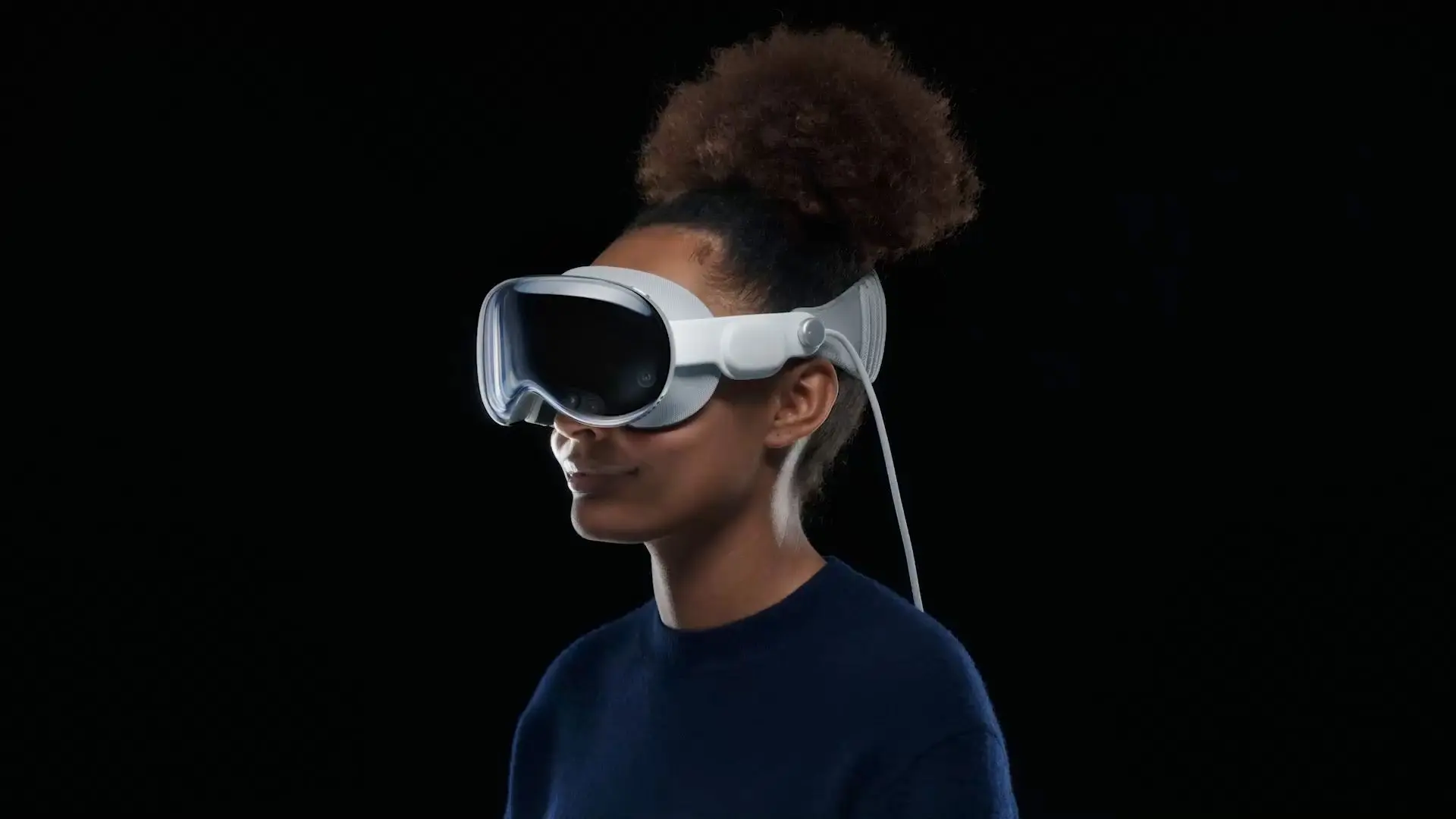
Apple Vision Pro is Apple's augmented and virtual reality headset, a major new product category. The first version launched in February 2024, and an updated model with an M5 chip arrived in October 2025. Apple calls it a spatial computer rather than a headset, emphasizing its ability to blend digital content with the physical world.
The Vision Pro is a mixed reality headset that displays augmented reality content overlaid on the world around you, as well as fully immersive virtual content. It uses cameras to map out your surroundings and translate them into a digital image. For virtual reality, the cameras can be shut off to isolate you completely. The shift between modes is controlled by a Digital Crown.
Design and Comfort
The design resembles ski goggles, with a single piece of laminated glass attached to an aluminum alloy frame. A soft Light Seal attaches magnetically to block out light. The M5 model includes a Dual Knit Band with two straps (one over the head, one behind) for better weight distribution and comfort. The original band was a single strap. The Dual Knit Band is breathable, cushiony, and has counterweights. It can be purchased separately for $99.
Display and EyeSight
The Vision Pro features two micro-OLED displays delivering over 4K resolution to each eye (23 million pixels total). The M5 chip can render 10% more pixels for sharper visuals and supports up to 120Hz refresh rates, reducing motion blur. An external EyeSight display shows the wearer's eyes to others, indicating whether they are in immersive mode.
Glasses wearers can use Zeiss Optical Inserts ($149 for prescription, $99 for readers) that attach magnetically. Prescriptions up to -11.00D to +6.75D are supported.
Navigation and Input
No physical controllers are included. Navigation relies on eye tracking, hand gestures, and voice commands. You look at an element to highlight it and tap your fingers to open it. Scrolling is done with a flick. Bluetooth keyboards, mice, trackpads, and game controllers can be connected. Optic ID uses iris scanning for authentication, similar to Face ID.
Cameras and Sensors
There are 12 cameras and five sensors, including infrared flood illuminators for hand tracking in low light, LiDAR for depth mapping, and eye-tracking cameras. The R1 chip processes camera and sensor input to stream images to the displays within 12 milliseconds, providing a near-lag-free view.
The Vision Pro can capture 3D photos and videos using a dedicated camera button. When recording, an animation on the external display notifies others.
Processors and Performance
The M5 chip, built on third-generation 3-nanometer technology, has a 10-core CPU (4 performance + 6 efficiency) and a 10-core GPU. It features a 16-core Neural Engine, 153GB/s memory bandwidth, and third-gen ray tracing. The R1 chip handles real-time camera and sensor data. The M5 provides up to 50% faster AI performance and improved graphics. The Vision Pro has 16GB RAM and storage options of 256GB, 512GB, or 1TB.
Battery Life
The external battery pack offers up to 3 hours of video playback or 2.5 hours of general use—half an hour more than the M2 model. The battery can be swapped for additional power, and the headset can run all day when plugged in.
visionOS and Software
visionOS 26, released in September 2025, introduced persistent widgets, more lifelike Personas, and the ability to share experiences with other Vision Pro users in the same room. A Jupiter Environment, the ability to view your iPhone while wearing the headset, and Spatial Scenes that add depth to 2D photos are also included.
The operating system supports Mac integration, allowing the Vision Pro to act as a single external display. With visionOS 2.2, Wide and Ultrawide modes were added, with Ultrawide equivalent to two 4K displays. A Travel Mode and Guest Mode are available.
Audio and Connectivity
Speakers built into the straps support Spatial Audio and adapt sound to the room. The AirPods Pro 2 (USB-C) and AirPods Pro 3 support lossless audio with low latency. The Vision Pro uses Wi-Fi 6 (not 6E) and Bluetooth 5.3.
Medical Warnings
Apple warns that users with heart conditions, migraines, dizziness, eye conditions, psychological conditions, or seizures should consult a doctor before using the headset. Pregnant individuals should also exercise caution. The battery pack may interfere with pacemakers and other electronic medical devices.
What's Next for Vision Pro
Smart Glasses
Apple is working on smart glasses similar to Meta Ray-Bans, with cameras, speakers, and an AI assistant. They are expected in late 2026 or 2027. The glasses will not have a display.
Cheaper Headset
Apple continues to develop technologies for a lighter, cheaper enclosed headset, but no new Vision Pro model is in active development. A next-generation headset is at least two years away.
Future plans include AR glasses and health-related features such as monitoring facial expressions for mental health and detecting signs of heart failure through eye-tracking.
Source: MacRumors News