

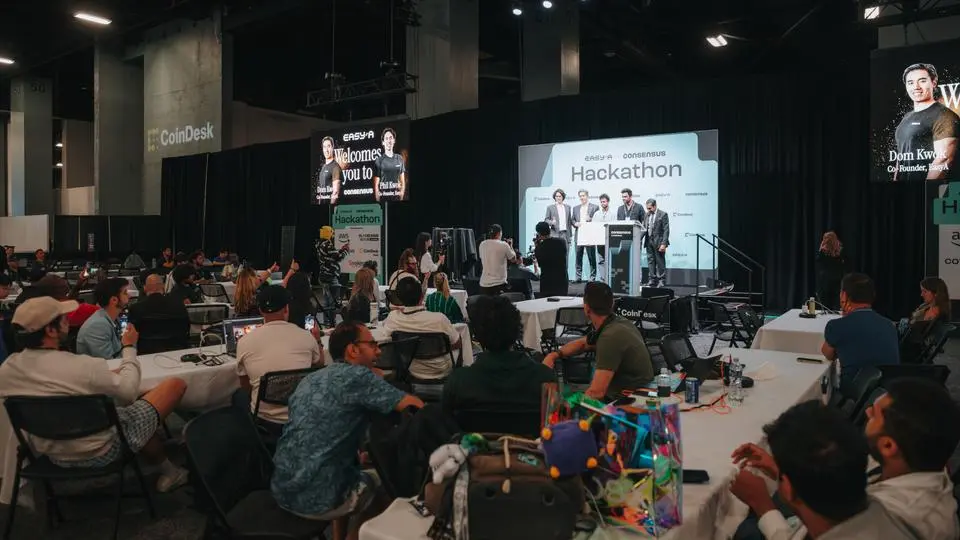
The intersection of artificial intelligence and cryptocurrency reached a fever pitch at the Consensus Miami 2026 EasyA hackathon, where nearly 1,000 developers from diverse crypto ecosystems and major tech companies converged to build AI-powered startups. The event, held at the bustling convention center, saw participants from Base, Solana, and other blockchain networks, alongside engineers from technology giants like Microsoft and Google, all racing to create products centered on the theme of AI agents.
AI agents are software programs that can autonomously perform tasks, make decisions, and interact with users or other systems. In the context of cryptocurrency and blockchain, these agents can manage wallets, execute trades, participate in decentralized finance (DeFi) protocols, and even create content. The hackathon showcased a remarkable range of projects, from autonomous payment systems that can handle recurring subscriptions to consumer apps that use natural language interfaces to interact with blockchain-based services.
One of the standout teams built a platform that uses AI agents to generate hardware designs for crypto mining rigs, optimizing energy efficiency and hash rate. Another team created a system of autonomous drones that can be programmed to perform tasks such as delivery or surveillance, with payments and task coordination managed entirely on-chain. Prediction markets also emerged as a popular category, with AI agents analyzing vast amounts of data to provide probabilities and automate bets on real-world events.
The Rise of AI Agents in Crypto
The dominance of AI agents at this year's hackathon reflects a broader trend in the crypto industry. Over the past year, projects like Autonolas, Fetch.ai, and Virtuals Protocol have gained traction by enabling the creation and coordination of autonomous agents on blockchain networks. These platforms allow developers to build agents that can perform specific functions, such as monitoring DeFi protocols for arbitrage opportunities or managing decentralized autonomous organizations (DAOs).
EasyA co-founder Dom Kwok emphasized that the hackathon is no longer just a coding competition but a genuine startup launchpad. "We've seen participants from previous EasyA hackathons go on to raise millions in venture funding and even enter Y Combinator," Kwok said. "Some of those companies are now valued in the billions. What we're witnessing here is the birth of the next generation of crypto startups, and AI agents are at the core of it."
His brother and co-founder Philip Kwok added, "The convergence of AI and crypto is inevitable. AI agents need a trustless, transparent environment to operate in, and blockchain provides that. At the same time, crypto applications need intelligent automation to scale. This hackathon is proof that developers see the potential."
A Diverse Developer Pool
The hackathon attracted participants from all over the world, with many traveling specifically for Consensus Miami. The ecosystem representation was broad: developers from Base, Solana, and Ethereum layer-2 networks competed alongside engineers from Microsoft's Azure blockchain team and Google's cloud Web3 group. The prize pool, sponsored by various foundations and venture capital firms, included tokens, grants, and direct investment opportunities.
Teams were given just 48 hours to conceive, build, and demo their projects. The atmosphere was intense but collaborative, with mentors from EasyA, CoinDesk, and partner organizations offering guidance on everything from smart contract security to tokenomics. Many participants noted that the quality of projects this year was exceptionally high, thanks in part to the maturity of AI tools like large language models and reinforcement learning frameworks that integrate seamlessly with blockchain APIs.
Notable Projects from the Hackathon
Among the most impressive projects was a decentralized payment agent called PayAgent. Built on Base, it allows users to set up autonomous recurring payments that can be funded by any ERC-20 token. The agent uses a large language model to interpret natural language instructions, such as "pay my rent every month from my USDC balance" and then executes the payment on time, even adjusting for gas fees and network congestion.
Another team created DroneLedger, a system that combines hardware drones with smart contracts. The drones are equipped with cameras and sensors, and their flight paths, data collection, and payments are managed by on-chain AI agents. This has potential applications in agriculture, logistics, and surveillance, where autonomous drones need to be trusted and compensated without human intervention.
On the consumer side, a group from Solana built a prediction market platform called PredictIQ. It uses AI agents to aggregate data from news feeds, social media, and financial reports to generate probability estimates for events like election outcomes, sports matches, and market movements. Users can then bet on these outcomes using the platform's native token, with the AI agent constantly updating odds in real-time.
The Evolution of EasyA Hackathons
EasyA has been organizing hackathons since 2018, initially focusing on Ethereum and smart contract development. Over time, the events have evolved to embrace new trends like DeFi, NFTs, and now AI agents. The Miami hackathon was the largest yet, with over 1,000 registered participants and more than 200 projects submitted. The top 20 teams were selected to present on the main stage at Consensus, where they pitched to a panel of judges including venture capitalists from Andreessen Horowitz, Paradigm, and Multicoin Capital.
Dom Kwok noted that the hackathon's success is also a testament to the broader crypto ecosystem's health. "We're seeing more developers entering the space than ever before, and they're building real, useful applications. The days of simple token clones are over. Now it's about autonomy, efficiency, and integration with the wider digital economy."
The hackathon also featured workshops and talks from industry leaders on topics such as zero-knowledge proofs, decentralized identity, and AI safety. These sessions helped participants understand the technical and ethical considerations of building autonomous systems on blockchain.
Broader Implications for Crypto and AI
The surge in AI agent development has significant implications for both the crypto and AI industries. For crypto, autonomous agents can greatly enhance the user experience by removing the need for constant human oversight. For instance, an AI agent can monitor a DeFi protocol for impermanent loss and automatically rebalance a user's liquidity pool position. Similarly, agents can execute complex trading strategies across multiple exchanges, arbitraging price differences in milliseconds.
For AI, blockchain provides a trustless execution environment where agents can be held accountable through smart contracts. This is particularly important for high-stakes applications like financial transactions or autonomous vehicles, where malicious agents could cause harm. By recording agent actions on an immutable ledger, it becomes possible to audit behavior and enforce penalties for misdeeds.
However, challenges remain. Scalability is a major concern as thousands of agents interact on-chain simultaneously. Layer-2 solutions like Base and Solana have made progress, but the demand from autonomous systems could push networks to their limits. Additionally, the security of AI agents themselves is a growing field of research, as hackers could attempt to manipulate agent decision-making through adversarial inputs or poisoned data.
Despite these hurdles, the enthusiasm at the EasyA hackathon suggests that developers are eager to tackle these problems. Several teams explicitly built their projects with modular and upgradeable designs, anticipating future improvements in both AI and blockchain infrastructure.
What's Next for the Winning Teams
The winners of the hackathon were announced on the final day of Consensus Miami. The top prize went to PayAgent, which received a $100,000 grant from the Base ecosystem fund along with a direct invitation to the next Y Combinator batch. Second place was awarded to DroneLedger, which earned a $50,000 grant from the Solana Foundation and mentorship from the EasyA team. Third place went to PredictIQ, which received a $25,000 grant and introductions to venture capital firms specializing in prediction markets.
All winning teams will also have the opportunity to participate in EasyA's accelerator program, which provides additional funding, technical support, and networking opportunities. Past graduates of the program have gone on to raise over $500 million collectively, and some have become household names in the crypto space.
For the developers who didn't place, the hackathon still offered immense value. Many participants reported making valuable connections with potential co-founders, investors, and employers. The collaborative spirit and high-energy environment left a lasting impression on everyone involved, reinforcing the idea that the crypto and AI communities are stronger together.
As Consensus Miami wrapped up, the buzz around AI agents continued to grow. Analysts predict that the market for autonomous AI agents on blockchain could exceed $100 billion within the next five years, driven by applications in finance, supply chain, gaming, and beyond. The ideas born at the EasyA hackathon may well be the foundation of that future.
Source: Coindesk News