

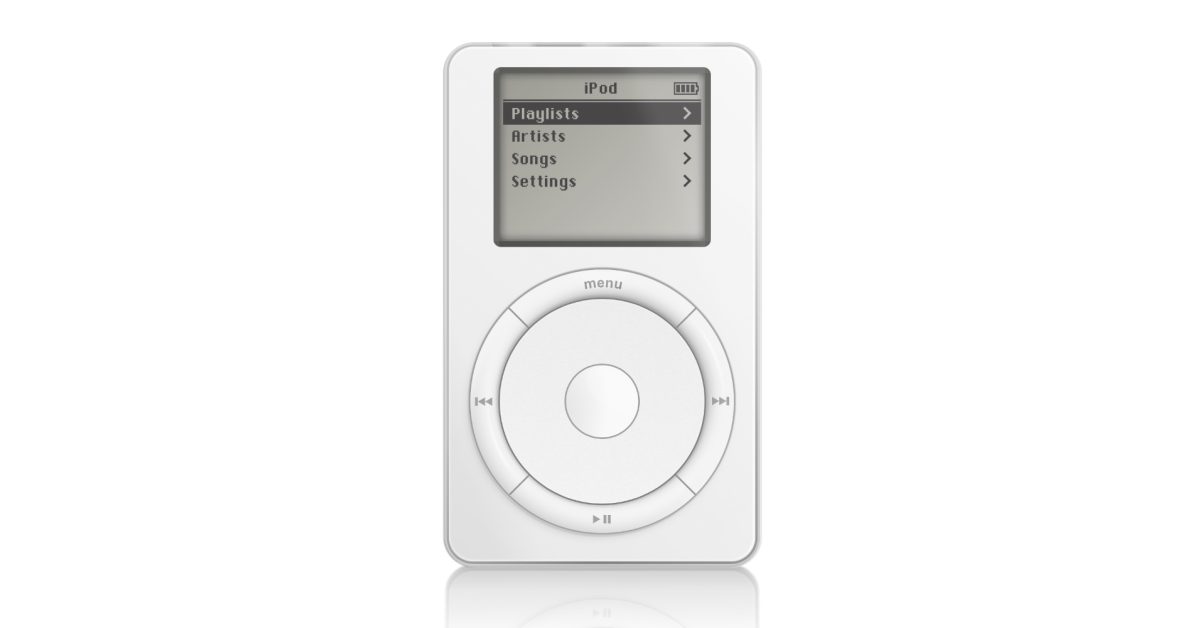
Apple unveiled the original iPod on October 23, 2001, and a quarter of a century later the company has marked the milestone with something considerably more playful than a press release. Visitors to Apple's music website are now being greeted by a detailed, fully interactive recreation of the first-generation iPod — hidden in plain sight on a page most people would never expect to find anything at all.
The device itself is long discontinued, and its successors have been retired one by one. But the little white player with the mechanical scroll wheel still occupies an outsized place in the memory of anyone who came of age between the Napster era and the arrival of the smartphone. Apple, it turns out, seems to know that.
The 404 page that plays music
The discovery is simple enough to reproduce. Anyone who navigates to the music section of Apple's website and appends a path that does not exist is served the standard Page Not Found screen. Ordinarily that is the end of the story — a dead end, a shrug, a click of the back button.
This week, however, that screen also renders a faithful recreation of the original iPod, complete with its white acrylic faceplate, its grey click wheel and the four small buttons arranged around it. Typing a path such as music.apple.com/ipod is the most direct route to the experience, though any other nonexistent path beneath the music subdomain appears to trigger the same result.
The timing is deliberate. October 23 marks exactly 25 years since Apple took the wraps off a device that many observers initially dismissed as an overpriced niche accessory for Mac owners. The intervening decades have settled that argument decisively.
Buttons that actually work
What makes the Easter egg notable is how far beyond a static image it goes. The click wheel responds to click-and-drag gestures, letting visitors spin through menus exactly as they once did with a thumb. The four buttons above the wheel scroll backwards and forwards through tracks and handle play and pause. A menu button steps back to the previous screen, and selecting an item pushes deeper into the interface.
The result is a browser-based simulation that behaves remarkably like the real hardware did in 2001 — including the satisfying sense of momentum when the wheel is flicked rather than dragged. For anyone who owned one of these devices, the muscle memory returns almost immediately.
The player ships with a small library of pre-installed tracks drawn from artists who were popular at the time of the original launch, a period when the charts were dominated by a very different mix of rock, pop, hip-hop and R&B than the streaming era produces today. Selecting a song begins a 90-second preview that streams directly inside the interface, so the whole experience stays contained within the browser.
The pitch that changed Apple
To understand why a 404 page is generating this much affection, it helps to remember what Apple looked like in the autumn of 2001. The company was four years removed from the return of Steve Jobs and still, overwhelmingly, a computer maker. The Macintosh was the product, the Mac was the platform, and the digital hub strategy was only beginning to take shape.
The iPod was announced at a modest event on Apple's campus rather than at a glitzy trade show. Its headline promise was disarmingly simple: 1,000 songs in your pocket. Inside was a 1.8-inch hard drive, a five-gigabyte capacity, a FireWire port for fast transfers and a battery rated for roughly ten hours of playback. The price was $399, a figure that drew immediate criticism from commentators who noted that rival MP3 players cost less.
What those critics missed was the integration. The iPod worked only with Macs at launch and depended on iTunes 2, but that dependence was the point: the hardware, the software and the syncing process had been designed together, and the scroll wheel turned navigation from a chore into something close to a pleasure. The industrial design, with its stainless steel back and mirrored finish, signalled that this was a premium object rather than a gadget.
An evolution in miniature
The first iPod was only the opening chapter. A second-generation model added touch-sensitive controls in 2002. The third generation, in 2003, introduced the dock connector and thinner proportions. The iPod mini arrived in 2004 in a spectrum of anodised aluminium colours and proved that smaller could be more desirable than bigger. Then came the flash-based iPod shuffle in early 2005, followed later that year by the iPod nano, which replaced the mini and shrank the entire experience to the size of a pencil.
The iPod touch, introduced in 2007, quietly foreshadowed the future. Stripped of the click wheel and built around a multitouch display, it was effectively an iPhone without the phone — a glimpse of a world in which the dedicated music player would be absorbed into something more general-purpose. That absorption is precisely what happened.
The store that followed the player
When the iTunes Music Store opened in April 2003, it did something the record industry had spent years resisting: it sold individual songs for 99 cents, with no subscription and no album purchase required. The store existed because the iPod existed, and the two reinforced each other. Within a few years, digital downloads had become the dominant revenue line for the music business.
That model, too, eventually gave way. Streaming subscriptions replaced ownership, and Apple's own answer arrived in 2015 with the launch of Apple Music, now priced at $11.99 per month in the United States, or available as part of an Apple One bundle. The iPod's software lineage — its menus, its sync logic, its seamless marriage of library and device — survives in the Music apps that ship on every modern Apple device.
The long goodbye
The retirement happened in stages. The iPod classic, the direct descendant of the original, was discontinued in September 2014. The nano and shuffle followed in July 2017, leaving only the iPod touch on the shelves. That final holdout was discontinued in May 2022, closing a product line that had sold an estimated 400 million units across more than two decades.
For a company that routinely kills products without ceremony, the persistence of iPod nostalgia is unusual. Apple has periodically leaned into it, referencing the device in marketing materials and keeping the name alive in support documents long after the last unit shipped. The new Easter egg is the most elaborate acknowledgement yet.
Why hide it on an error page?
The choice of placement is itself part of the charm. Error pages are the dead space of the web, the places users land when something has gone wrong. Filling one with a working replica of a beloved product turns a moment of mild frustration into a small discovery — and discovery is what makes an Easter egg work.
Apple has historically been restrained about hidden content, preferring tight control over its public surfaces. But the company has also shown a willingness to be whimsical when it costs nothing and delights people who are paying attention. A 404 page is the ideal venue: invisible to anyone in a hurry, generous to anyone who lingers.
There is also a practical dimension. The recreation demonstrates what is possible in a modern browser — a physics-flavoured wheel, responsive menu navigation and streaming audio, all without a plugin or an app. It is a technical flex dressed up as nostalgia.
The case for a dedicated player
The obvious question the Easter egg raises is whether Apple should ever build a hardware iPod again. The commercial logic is unforgiving: the iPhone already plays music, Apple Music already streams it, and AirPods already deliver it wirelessly. A dedicated player would compete with Apple's own best-selling product.
Yet the appeal persists for reasons that have little to do with specifications. A single-purpose device does not buzz with notifications, does not compete for attention, does not know where you are. It plays music, and then it stops. For listeners who remember the ritual of syncing a library the night before a long trip, the absence of that friction-free, distraction-free experience is a genuine loss.
Specialist manufacturers have stepped into that gap with high-resolution players aimed at audiophiles, and vinyl sales have grown for more than a decade on much the same impulse: the desire for a bounded, deliberate way of listening. Apple has shown no inclination to re-enter the category.
What it has done instead is preserve the idea in miniature. The interactive iPod on the error page offers a working scroll wheel, a handful of period-appropriate songs and 90 seconds of each. It lasts as long as the visitor wants it to, and then it disappears back into the architecture of the web.
Source: 9to5Mac News